Tag: mobile applications Page 8 of 10

The New Mobile Apps: Head in the Cloud!?

Everyone with an iPhone will by now have seen and “played” them: the first generation of multi-player games where most of the computing is done in the cloud, relieving the handset from such labourious tasks. This, according to new report, will soon (well, by 2014) be the norm and will in fact erase downloadable apps (games and other) as we know them today.

The huge advantage of this approach is that it would largely do away with the fragmentation nightmare of the handset market: multiple operating systems, a plethora of screen sizes, all sorts of “interesting” middle-ware solution imposed by either carriers (Sprint anyone?) or OEM to “tweak” an OS to their specs, with the sole result of making things even more cumbersome for developers. It is one reason why the Apple iPhone ecosystem thrives as it does: one OS, one model, one distribution channel, worldwide deployment. If the heavy-lifting is done in the cloud rather than on the handset, one can – presumably – do away with less complex front-ends reducing the work necessary to port the app to various handsets (and, no, please do not choose iMob as the benchmark!). Coding for the cloud would resemble web development rather than today’s mass market application development with armies of post-production and QA engineers filling offices (and overall development costs).

Another, easily overlooked, advantage is battery life: the more (and more complex) processes are computed on the phone hardware, the more the device will consume of the precious and scarce juice; battery life is better with cloud computing!

The obvious downside of mobile cloud computing is a blue sky: no cloud, no app. In posh tech lingo: intermittent network availability, which is to say that the app won’t work if you have no coverage (so no displacing downloadable apps in Oklahoma or on the Scottish isles then…). The aforementioned report suggests HTML 5 and its more sophisticated caching options as the solutions but I am fairly skeptical in that respect: you will not bring about the “unprecedented” sophistication with a little bit of cached data.

Anyway, the more likely scenario is an abundance of network availability by 2014 anyway: by then, large parts of our computing will be done over the air and LTE (and further evolved) networks will surely rule good parts of the world.
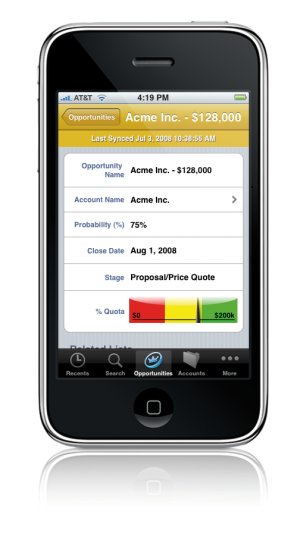
So, will it work? The report points out iPhone apps for the likes of Amazon, eBay, etc and, yes, for such apps I am sure it will work: they basically extend a front-end of a web service to a mobile device. The “app” is basically a client that facilitates input and serves as a crutch for the smaller screen where it is necessary to optimise the available data so as not to overburden the little available space with non-core information.

Will it work for more complex apps, in particular games? It will depend. On what? On the type of game of course! How many online racing games do you know? I mean really good ones. None? Ah… Why is that? Because not even the abundance of bandwidth and computing power available today gets to a game experience even close to the 50+ frames per second that the top iPhone racing games can do today (check out Firemint’s Real Racing!). The experience on next-gen consoles is even more astonishing. Need for Speed: Under Cover on XBox 360 or PS3? Woah! All these games require very serious hardware acceleration to convert the high-end graphics into smooth, fast, flowing action. And broadband networks aren’t good enough for that. Period.

For other games, turn-based card games, board games, the Sims, or indeed full-blown MMO, this is another story. These games may require a lot of data but the speed is not as important for good gameplay. So for this group (which is arguably the larger one), cloud computing will probably be the way forward. The opportunity exists in particular (and will be largely sufficient) for all “serious” business applications: these feed for the most part off server-side data sets already and a light mobile client (or browser?) is all they need to provide serious productivity boosts to the corporate world.

So will these run in a (mobile-optimised) browser or via (lighter) downloadable front-end apps? Due to the constraints of the small screen, I believe it will remain very beneficial to the UI and playability to have a specific front-end (and core graphics and processes) on your handset because it will optimise the user experience on a mobile device. To keep this bit as generic and light will be key. Otherwise, it would be porting hell all over again.

But we’ll get there! Just watch out!

Are you Smarter…?

mathbordThe sales power of the Apple App Store is legendary with its 1bn+ downloads in record time. I have repeatedly held though that the other end of this ecosystem, i.e. the entry door to the app store (and related SDK and all) – and its relative ease of use – was an equally imporant contributor to Apple’s success. And now we have a beautiful example on how cool this really is: in Chicago, an 11-year old and his 9-year-old brother designed and programmed an application called “MathTime” that has just gone live on the app store. It provides random addition, subtraction, multiplication or division problems and their solutions.

The creators, Owen and Finn Voorhees, worked on it for 9 months and it is now live on the app store, which means available for sale in every country the iPhone is currently available – on deck so to speak! Try this with a J2ME app…

Now, I do not want to belittle Owen’s efforts (it is spectacularly awesome for any 11-year-old!) but this would arguably not have been possible on any other (mobile) software platform. Even if some smart kid might be able to write such a programme. To get it into live distribution on official on-device app stores (or operator portals) would be just utterly unthinkable. Try close those deals with all them operators. Good luck.

I have not seen the MathTime in action but since Apple approved it to go live, it must have passed at least certain thresholds. The whole ecosystem on any of the “classic” carrier channels would have thwarted any attempt to do the same. Would it have worked on Android Market? On the Blackberry App World? Nokia Ovi? I don’t know but it does not really matter since they are basically only further iterations of the model that Apple came out with first: a cr0ss-carrier, multi-territory, single-SKU deployment channel with a fairly regulated development environment. Fragmentation? Hah! Multi-channel distribution? What?

It is here where we should sing Apple’s praise: to make it possible that 5th graders can not only write but publish an application is truly stunning! That their dad needs to front it as the seller for being the only adult involved in the process is then only a touching and even more pronounced little detail, isn’t it?

Vodafone's App Store: Bigger than Apple?

It was only a question of time before the first carriers would release themselves from the iPhone-imposed stare and come out all action, and the biggest of them all (by sales), Vodafone, has now raised the curtains on its very own app store. It is the biggest app store to date: Vodafone has more than 289m customers who will – eventually – all be able to access the store (which makes it a cool 8x or so larger than Apple’s). Unlike on Apple’s App Store, you also do not need a credit card (which, however, you are likely to have anyway when you can afford an iPhone) whereas Vodafone, being a carrier, will bill to their customer’s phone bills directly. Very, very cool, huh?

So imagine the power of an app that would go live on Vodafone’s carriers all at once. But before we get carried away, let’s have a look at the numbers:
Orange UK (in its recently released Digital Media Index; see here) suggested that 4.87% of its users downloaded one game in 2008 (770,000 downloads p.a./ 15.8m users) but this is without an app store but with the traditional catalogue-style offerings.
For Vodafone Group, this would equate to 38,500 downloads per day (289m x 4.87% / 365). If (or when) it includes this offering beyond its own 27 local carriers to its 40 network partners (including Verizon Wireless!), one would be looking at North of 1bn users and, hence, 100,000+ downloads per day. Now, with an app store, this should – theoretically – be further boosted, let’s say doubled, arriving at 200,000 downloads per day.

How does this compare with everyone’s darling/nemesis (delete as appropriate), the iPhone: I had previously calculated that Apple’s app store sees some 4,000 per minute or 5.7m per day… This however includes all those free downloads (about 22% of all apps are for free), so let’s say the ratio is 1 paid: for 40 free (which is on the high end of assumptions) or 1:15. This would equate to 144,000 to 380,000 paid downloads per day. So Vodafone’s 200,000 wouldn’t look completely out of order, would it?
There’s even more: Vodafone’s decision to bill to the phone bill is only one potential booster since it minimizes friction for the user (Apple: credit card/iTunes account, Blackberry: PayPal, Nokia Ovi: a mix?, etc). The other – and longer-term potentially even bigger one – is geo-awareness: since Vodafone owns the network, it knows where any of “its” users’ mobile is at any given time. Now link app usage with geographical location and you could be on to something fairly unique. There is little in the market so far but then: had Apple run its campaign of “bettering life’s little problems” in June 2008, it would have looked fairly bleak, too!
So: huge potential but where are the pitfalls?
There’s UI and handset fragmentation, if I dare say so. Even though it probably hurts by now, let me repeat: Apple has one model and one deployment method and it nailed content discovery (not perfectly but better than anyone else). Job done. Vodafone has hundreds of handsets on its “to be supported” list. Some are like the Porsche’s of their trade (“first available on s60 devices“; ooooh), others are the equivalent to a pedal-powered toy car. The costs for developers to support all these is significant, the cost of management is arguably, too.
Most importantly though, it takes the simplicity and thus ease of use out of the game. And I would posit that this is a big contributor to the (Apple) app store’s success: simplicity from entry (ingest an app into the store), management (price, etc) to consumption (download and active use). This will be a tough one for Vodafone to overcome, and it is indeed the one point where OEMs have much better opportunities to “get it right”. That the relationship between carriers and OEMs is not always without strain has only recently been proven again, sooooo: the jury is probably still out on that one.
Having said this, Vodafone is better positioned than most carriers though because of its sheer size and footprint. Smaller carriers might struggle to offer developers similar incentives to support their respective offering because they don’t scale as well.
For Vodafone, I am concerned that the multi-level complexities they have to deal with (number of handsets x number of operating companies x number of languages x all additional info [geographical and otherwise]) might pose a strain on its ability to roll out quickly and decisively. It might not be as huge and life-changing as Apple’s app store but it would certainly lift the “mainstream” of app downloads to whole new level. I am an optimist, so, come on, Voda!

Games Pulsating Through One Platform?

Here’s one that nearly slipped through the (well, at least my) net: according to a recent press release, the Eclipse Foundation is set to unveil a unified development platform. It is said that some major players, including Nokia, RIM, Sony Ericsson, IBM and Motorola have joined this initiative already though Android and – predictably – Microsoft and Apple are notable in their absence.

The concept is oh so simple: a developer goes to the site, downloads the platform and is ready to rumble. The platform (called Pulsar) would pull together vendor-specific SDKs and off you go. It is clearly geared to tackle the fragmentation of the many, many handsets to be addressed when publishing to “mainstream” mobile phones.
At present, it’s an initiative (as there have been so many) and the presence of industry heavyweights does not always guarantee their success. I am (cynicism coming with age…) cautious over black box approaches (remember Tira Wireless?). I would love to see this succeed but let’s see what it comes to…
Image credit: digitalvish.com

Top 10 Smartphone Games & Apps 2008

Smartphone content vendor Handango releases a smartphone “yardstick” every year containing the top sellers from data in their store. Anecdotally, smartphone apps are more often sold via direct stores (rather than operator decks) than “normal” (not smart?) phones, owing of course to the better connectability (not necessarily connectivity) of high-end phones: input mechanisms (Querty, touchscreen, better D-pads), almost always 3G phones, etc make for a more satisfying user experience (try inputting a web URL via a basic phone keypad… painful!).


They had just under 10,000 apps on offer (spread across Blackberry, Windows Mobile [pro and standard], Palm, Symbian and Android). The average price point was a rather healthy $19, and users downloaded 1.12 apps on average.

Handango also says that games rose as part of overall “top category” sales (whatever that is) from 11% in 2007 to 19% in 2008. This is encouraging. Even so, there is no game amongst their overall best-sellers for 2008. Here’s the list (price points at the end of each line):
1. Spb Mobile Shell 2.1.4 (today screen plug-in) – $29.95
2. MobiTV (streaming television) – $9.99/month
3. Ringtone Megaplex (ringtones) – $19.95
4. Spb Backup 2.0.1 (file backup) – $24.95
5. Spb Pocket Plus 4.0.2 (today screen plug-in) – $29.95
6. Pocket Informant 8 (today screen plug-in) – $29.95
7. Spb Phone Suite 1.3 (phone features) – $19.95
8. VoiceControl (voice command) – $6.00
9. Colour Your Trackball (trackball customizer) – $4.95
10. eWallet (Professional Edition) (PIM manager) – $29.95

The top 10 games across platforms for smartphones is this:

1. Spb Brain Evolution 1.2 (puzzle game)
2. Aces Texas Hold’em® – No Limit (card game)
3. TETRIS (puzzle game)
4. Guitar Hero 3 Mobile (music game)
5. Bejeweled (puzzle game)
6. Aces Solitaire Pack (card game)
7. The Sims 2 (strategy game)
8. Jewelrumble 2 (puzzle game)9. Sudoku Puzzle Pack (puzzle game)
10. Solitaire Buddy Gold (card game)

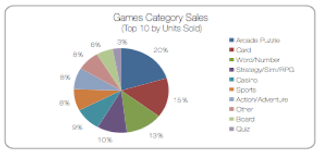
And here’s a chart of the game categories – and, no, still no first-person-shooters in the top 10:

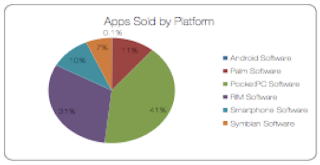
A noteworthy bit in the “Yardstick” is that Android already makes up for 10% of their sales (or so would the below graphic tell us). 

From this, it also occurs that Handango does not consider the iPhone to being very smart. Hm… Well, it’s probably that everyone who buys content on that one will buy not buy it from Handango but through the AppStore. OK then…

Apple AppStore Rises and Rises: Now Past 500 Million Downloads!

It is quite breathtaking: it took them 3 months to hit 100m. Then, only 5 weeks after they announced that they went past 300 million downloads, Apple announced that they just raced past 500 million. This means 200 million downloads in 5 weeks, 40 million per week, 5.7 million per day or 4,000 per minute! Get that! Whilst numbers don’t equate to happiness, I sincerely hope that Steve Jobs will be taking some comfort from this and recover well.

I will not tire of harping about the (nigh) flawless end-to-end experience that enables that: a gaming experience that challenges “traditional” handheld gaming devices like Nintendo DS and Sony PSP, an interface that promotes games beyond the hardcore crowd, connectivity that allows “social gaming” to evolve (see also here), and a purchase experience that does not force a user through onerous double-digit-click orgies and various ominous warnings.
So despite the fact that we still do not have clearer numbers illuminating the underlying commercials of the average application and game on their, I tip my hat, I take a bow, I applaud…

AT&T to go all Symbian

An article tells us that AT&T Wireless intends to run all their phones on one platform as soon as 2014, namely on Symbian. Is this odd? I mean: the iPhone isn’t Symbian, is it? 

It is of course not odd. The carrier wants to avoid platform fragmentation (see also here and here) which has made it hard to develop mobile applications (and one might well now think that they indeed had a very powerful showcase paraded past them over the last 5 months: see here), and their Director of Next Generation Services, Data Product Realization (can’t they have shorter job titles?), Roger Smith called Symbian “a very credible and likely candidate” to be “the One”.
AT&T intends to
 provide an own-branded smartphones and they reckon – rightly! – that it would be a “support nightmare” would they run this on various platforms.

Mr Smith also came up with some damning verdicts about J2ME: it failed to deliver a simplification for application developers and, moreover, doesn’t allow developers to get deeply enough into a phone’s OS to deliver the kind of experiences consumers want (what are these, I ask? Not having to put up with clunky and unintuitive restrictions? Ah, now I get it).
Symbian, Android (see here) or another one: the path is, I reckon, the right one. And it is a milestone for Symbian (and one probably only possible because of the decision to go open source with it) as it would wrap up one of the largest carriers in the world under its wings.

Page 8 of 10

Powered by WordPress & Theme by Anders Norén