Tag: iphone Page 10 of 16

To Skype or not to Skype: Nokia vs Carriers

The most excellent German blog Mobile Zeitgeist alerted me (in German) to a little battle that illustrates the pitfalls of creating the seamless user experience: Nokia appears to being in a tussle with (at least) the German arms of Vodafone and T-Mobile over the pre-installation of Skype clients on some of its forthcoming handset models (including the long-awaited iPhone competitor, N97).

Vodafone and T-Mobile Germany (who have a combined subscriber base of close to 80m) have now publicly stated that they will not include any Nokia models into their catalogues, which will have Skype installed. Now, there’s a market gone dead then… For other models, look to 3 in the UK (and my post on the Skypephone there…).
T-Mobile said that they “would not let their business be destroyed” by this. Their terms and conditions prohibited VoIP clients already but the carriers did anecdotally turn a blind eye towards this in the past. Nokia’s push however now is apparently too much for the carriers who fear network issues. Interestingly, this surfaces on the same day where, in anther part of the world, some queried the sustainability of free data plans for the iPhone (namely the Wall Street Journal on AT&T’s policies in respect of the iPhone). Predictably, Skype lambasted the move as “unfair practice”.

The name of the game is – of course – the pipe (not new: see e.g. here and here): the WSJ quotes from an Alcatel-Lucent analysis of North American networks during the midday hour of one day, which apparently shows that web browsing consumed 32% of data-related airtime but 69% of bandwidth whereas e-mail used 30% of data airtime but only 4% of bandwidth. The reasoning goes that increased data traffic impacts the networks’ capex whilst remaining – at best – ARPU-neutral (AT&T ponders to drop its data plan for the iPhone by $10), cutting down margins and hurting the carrier more than is healthy. Voice and SMS services are – on a bit for bit basis – very, very profitable as they use very little bandwidth.
To conclude though – as the WSJ does – that unlimited data plans should be abandoned “in the short term”, pours the baby out with the bathwater: smartphones are paving the way into the wireless future (20% of US households are completely wirefree already!) and it is a space where the carriers have great gains to make; maybe not on the sumptuous margins they were used to but healthy and viable nonetheless. To do as the WSJ asks would be as if one would have asked ISPs to please stop flat-rate plans for Internet access; and look what has become of the Internet!
Accordingly, other voices argue that a) slowing voice ARPU is at least being part set-off by increasing data ARPU (which grew a healthy 32% year-on-year in Q1 and saw more than $10bn in wireless data plans being sold in the US for the first time), and b) that the carriers actually know this for a while now and, accordingly, upgrade their networks to better cope with higher bandwidth demands in order to make the move to data pipes; the fight is arguably now “only” about whether these would be dumb or smart: with app stores, VAS and business-to-business (and machine-to-machine) solutions opening up vast new segments that have been completely unexploited to date, one should think that there is room for the smart pipe operator. So fear not!

Nokia Ovi's 20,000+

Nokia’s interpretation of an app store will be Ovi, and it will launch later this month. This is a biggie since Nokia (according to its own numbers) still commands an imposing market share of – globally – 37%. True to its huge self, it now said it’ll come out with all its guns blazing and kick its app store off with no less than 20,000 “items”! This is being compared to Apple’s “few hundred” upon launch.

However, that contains of course quite a bit of a PR spin: Nokia does not only include applications in its count but also videos and “mobisodes”, and on this definition, one would need to count in the 40,000 or so videos, 3,000 TV shows, etc that the iPhone had on offer via iTunes (numbers via Wikipedia).

So where does Nokia truly stand in May 2009? The company, once famed for cool design (7110 – also known as the “Matrix” phone anyone?) and intuitive UI (yes, really: in the pre-Java age, Nokia’s were second to none when it came to usability and interface) seems to have lost a little of its gloss. Its devices still boast technical excellence (the N96 technically outsmarts every iPhone or Android device easily) but the sex-appeal is considerably lower. Nokia anno 2009 has a little more of a Siemens-like flavour: very well engineered but a bit dull and maybe, well, a little over-engineered. At a time when content finally seems to go mainstream, this is more than only unfortunate: Nokia’s often announced push into the US (where it holds an uncharacteristically small market share) has faltered (again) but the company also seems to lose market share in regions where it previously was unassailable. Moreover, its incremental products, such as the Navteq business, appear to struggle, too (Navteq recorded net sales of only €132m in Q1/2009; compare that to a purchase price of $8.1bn!), as it is arguably being challenged by the – free – Google Maps (which most people I know prefer over the – paid-for – Navteq services).

Nokia’s competition comes less from its traditional foes, Sony Ericsson (struggling itself), Samsung, LG or Motorola but from the newbies like Apple, RIM or HTC, all of which focus on the upper end of the market and leverage this with smart phones that comes – app store or not – with a vastly expanded range of apps and services. Apple has leveraged this in breathtaking ways but one must not forget the gains Blackberry-maker RIM has realized. And while this was not on the back of its app store (Blackberry App World launched only recently), Blackberry devices had always been used for more than only voice and SMS – data services were always at the core of the product.
So where will Ovi sit? Will it revolutionize the mobile phone mass market on the content side, too? Nokia’s attempts so far were something of a mixed bag: Preminet must probably considered a failure, its successor NCD (Nokia Content Discoverer) was always a little bit in the shadows, too. N-Gage is a distinctly high-end service (with – anecdotally – 1m or so subscribers, which is small when you look at Nokia’s overall market footprint), the P2P service Mosh was known (to the people who actually did know of it) for the piracy taking place on the platform rather than for commercial success. In short: Nokia’s moves into content have not been an overwhelming success so far. Ovi has the opportunity to change this. Due to its massive market footprint, Nokia has the opportunity to turn more than 1bn devices into shop windows for content, and this outmuscles anything Apple could even dream of achieving by large margins.
However, the success of an app store is not being defined by the sheer number of content available on or through it but but at least equally by the functionality, the usability and discovery. This is where Apple has been doing so well: the combination and seamless integration of hardware and software and its content strategy out of one mould (with no carrier intervention at all) has lifted the bar for an interface significantly. It might look easy to copy this but it is not. Nokia has also been very (!) late to the game (bear in mind they first announced Ovi in 2007!), and it acknowledges this itself. It will therefore be very interesting to see how Nokia manages to execute it. Be not mistaken: if it succeeds, the content revolution on mobile has truly begun!

Top 5 US Smartphones in Q1 2009

After all the talk (and more talk) about Apple’s iPhone, a new report provides some new numbers reminding everyone that there are more phones on this earth than the sleek one from Cupertino. It is not about the iPhone (or not only) but about Blackberry, the iPhone, Blackberry and Blackberry. Yes, this is the first four places in the top-selling smartphones in the US in Q1/2009 according to market research specialists NPD Group (it is only the press release, so pretty lean on information).

Also: completing the top 5 is a phone with an open-source OS, namely the T-Mobile G1 (the first Android handset). I will be interesting to see if there is more to come from this last group (see my post on the state of play of open-source operating systems here).

So the top 5 are:

  1. RIM BlackBerry Curve (all 83XX models)
  2. Apple iPhone 3G (all models)
  3. RIM BlackBerry Storm
  4. RIM BlackBerry Pearl (all models, except flip)
  5. T-Mobile G1
So: even though they counted all of the 3G iPhones in, they still could not beat the Blackberry Curve. Well done, RIM!

The Others: Where Android, Symbian & LiMo are

The title of this post is not meant in any way derogatory but with all the hype about the iPhone it is sometimes easy to forget that we are talking about a niche product that will probably remain a niche product (albeit a powerful and cool one!). In the rest of the world (feature phones aside), a few consortia are fighting for the open-source market, which is – let’s face it – a considerably larger piece than the small premium segment served by Apple.

So, where were we? There is the LiMo Foundation, which is onto establishing a mobile Linux standard. There is the Symbian Foundation and there is Android, a Linux-based OS from the Open Handset Alliance led by Google. One by one then:
LiMo Foundation

LiMo boasts a membership based comprised of the Who’s Who in mobile. Powerhouses from around the world like Vodafone, Orange,
Verizon Wireless, NTT DoCoMo, Telefonica, SFR, TIM and SK Telecom, Samsung, NEC, LG, Panasonic, Huawei, Motorola, and ZTE (and quite a few more) are all in there. LiMo has released an SDK a while ago. Now though, they decided that enough is enough and that the world should know that their OS was actually making headway. In 2009, there will be new handsets based on LiMo’s s
tandards released by Orange, Telefonica, Vodafone, NTT DoCoMo, SK Telecom and Verizon Wireless. Now, that’s a statement. Non-phone devices are in the works, they say…
There are already more than 20 LiMo phones out there (without very many people having realized it). They include such mundane devices like Motorola’s U9, ROKR EM30, ROKR Z6 and ROKR E8 as well as the RAZR2. Panasonic and NEC pboth produced a whole raft of devices for NTT DoCoMo. See here for a list of available phones.
Symbian

Symbian of course is coming from a differen
t mould: having been (co-)owned by Nokia for, like, ever, there are already over 200m devices running on its OS. After going open-source, they are working on consolidating the sister formats S60, UIQ and MOAP(S) now into one. Membership-wise, they’re not doing badly either: they target to having more than 100 members by year-end. Membership with them is only $1,500 p.a. It remains to be seen to what extent they will extend their handset footprint beyond Nokia though. Little has been heard so far…
Android

Both foundations felt compelled to state their cause, also in response to Eric Schmidt’s continued mantra that 2009 will be very, very strong for Android. The Open Handset Alliance had gone off to a well-publicized start with the T-Mobile G1. They recently announced that it had sold 1m devices (regarding which some people pointed out that Apple shipped as many iPhones on the first weekend), and are now gearing up more devices for launch (Vodafone got its hands on the HTC Magic). Samsung, LG, HTC and Sony Ericsson have all announced Android devices this year, and the first Samsung (I7500) has just been officially confirmed.
Multiple Membership
Wait a minute? Samsung? Weren’t they part of the LiMo foundation? Well, yes, and that is part of the problem: a lot of the big players have their fingers in all the pies (and why should they not?). This is favouring Apple since they are a single organization producing hardware and software. It could also be argued that it is favouring Android because Google throws so much marketing and PR behind it. However, maybe not. The big OEMs and the big carriers all work according to their own agenda. And this might very well be a very different one to Eric Schmidt’s: to an OEM, production cost, stability and versatility without impacting standardization are key. To a carrier, a lot will (also) ride on the ability to customize the handset so as to give it a distinct branded feel. Less PR from someone like Google makes it easier to them to focus on their own brand.
So: rock-solid, clean code, transparent and clear SDKs, no hidden hooks will mean that a lot of the feature phones that create the vast majority of handset sales (even if sales of the “classic” J2ME ones had been declining in 2008 when compared to smartphones) will quite possibly see a larger and larger move towards the open platforms. It makes it cheaper to produce and, with Apple having given the world the app store idea, content should flow in sooner or later. They “only” need to keep the standards, well, standard!
The iPhone is of course looming large, and it is the one device that has shown the old school of the telco world how 21-st-century marketing can impact market perception and sales. They have also all realized that this might actually be a very good thing, hence the eager discussions many are purported to be having on getting their hands on the next generation. However, last time I looked, the streets were not full of Porsche Boxsters either. Quite a few Hyundais, Fiats, Peugeots, BMWs, Volvos, well, you get it…

Why an iPhone Deal with Verizon Wireless would be Cool

Today, interesting reports surfaced (or re-surfaced?) according to which Verizon Wireless and Apple are in discussions about bringing the iPhone to the former. However, because Verizon runs on a CDMA network and Apple has only ever supported GSM, commentators reckoned that this deal might be for Verizon’s next-generation LTE network. And this is when one can start dreaming…

To recap: Verizon will be amongst the (if not The) first tier-1 network operators rolling out the next generation of wireless networks under the LTE standard (see here for more on this). Under LTE, unprecedented wireless bandwidth will be available, comparable (or exceeding) what households in Western and Far-Eastern countries have in their homes today. But then you would have it of course wherever you are (well, if the respective technology is installed).
Due to the immense speeds, a lot of people think that the first big change will be on the (computer) broadband side of things: no need for wireline access if the speeds are the same and you can actually wander around and through town and always be with your provider. Simplicity, ease of use, bliss of connected life.

When it comes to mobile handsets (previously known as phones), the iPhone is of course (and despite the heckling by its many critics) arguably the most successful multimedia device known to man (so far). To marry this with these speeds? Ah, what would await us (see here for earlier thoughts). The iPhone (if they can fix the battery life) would be perfectly suited to bring the new lush wireless life to the masses (albeit first to the more affluent ones): rich graphics, innovative inputs and the fairly unique form factor would show the opportunities off rather beautifully and could hence aid to avoid the post-3G hangover where people asked themselves why on earth they should get 3G phones: there was nothing much to do with them (other than being able to make “faster” phone calls…).
The most common uses would arguably be music and apps with the latter being even more successful than the former: it is estimated that iTunes took 6 years to record 6.8 bn downloads; the App Store did 1 bn in only 9 months (or 1.3bn p.a.), which would equal 7.8 bn in 6 years if no further growth would occur. Anyway, with 1.1 bn downloads p.a. not being too shabby either, let’s take both, so what do we get?
On the music side, it would either mean quick and high-quality downloads or, more likely (?), streamed music. The same applies to the VOD and movie segments.
On the apps side, LTE would arguably push the envelope into two directions: (1) high-end, graphically rich games, and (2) ultra-connected social games that seamlessly bridge media platforms. Now: both types had their advent on the iPhone. Speak to any number of high-end games makers, and they will tell you that their life became much easier since the iPhone was there. Look at products like EA’s Scrabble (with full Facebook integration), Playfish‘s games (coming from the other end, i.e. from Facebook to iPhone), etc and you have the foundations laid here, too. With LTE, all this becomes mass-marketable to a much higher extent. And this would be real fun!

iPhone all-time top 20 apps, countdown to 1bn downloads

I’ve been raving about it many a time and I still won’t stop but then: Apple does neither. When, waaaay back in January, I looked last, the App Store had raced through 500 million downloads and I calculated this to equate 4,000 per minute. Well, that’s history: We’re now through a 948 million total (count taken on 13 April, 11.23pm UK time from Apple’s site [check the little clock]) and look at 6,000 downloads per minute (or 100 every second of every minute of every hour of every day!) or so some learned friends have summed it up to.
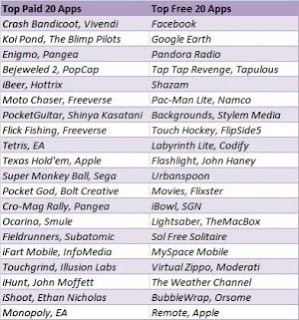
Apple also revealed a list of the top 20 all-time top downloads, both paid and free, which (courtesy of MoCoNews) is this:
So here’s the good stuff for my gaming friends: 14 out of the top 20 paid apps are games! Yes, baby! 6 out of the top 20 free ones are, too. Way to go! I haven’t looked at the pricing for the above paid apps but MoCoNews did: ¢99 is the prevailing price-point at the moment but $4.99 seems to be the price point of choice for “premium” games.

Carnival of the Mobilists #166

This week’s Carnival of the Mobilists is hosted by the formidable Caroline Lewko at WIP Jam. I am very happy to note that my latest post on Apple’s growing relevance as a gaming platform is included in last week’s line-up. For the remainder, there’s stuff on LiMo (for some background on where they came from see here) and some very worthwhile piece on mobile marketing amongst much more. And now go to read it here!

Page 10 of 16

Powered by WordPress & Theme by Anders Norén