Tag: iphone Page 11 of 16

Apple's Gaming Platform

I wrote about this topic a couple of times already (here and here) but here‘s an interesting update/summary. The gist of the argument remains, only the numbers got better: Microsoft’s XBox has sold 29 million units, and that is fairly respectable (in particular when you consider that people regularly fork out $30 and more per game). Apple however (Mr Gates, I hate to say it) outsold its dear competitor by selling more than 30 million iPhones (and, well, iPod Touch).
The hardware install base is fairly similar then. There are two differentiators (besides the price point as per above and the fact that an XBox is not so portable nor meant to be): 1) Apple took a lot less time to get there, and 2) there are more than 25,000 applications for the iPhone, of which about 1/4 are games. That’s a lot!
And with its fairly awe-inspiring iPhone 3.0 update (more here or watch the entire keynote), one can now also add in-game micro-payments to the mix, which enhances the flexibility of billing models beyond anything its console or handheld rivals have on offer. Add to this the points raised in my earlier posts and the neat additions to the new iPhone SDK (use music stored on the device in the game, in-game voice chat, push notification waking up an app, stereo Bluetooth, etc, etc) and we are hopefully to see yet another wave of innovative, intelligent implementations of this. It is pretty cool indeed!

iPhone Dominates the Mobile Web (as yet)

The iPhone has a meagre 1.2% share of the overall phone market. However, it has true worker bees as users. No, honestly, these guys are sooo much busier than everybody else: they produce a whopping 2/3 of the world’s mobile web traffic, or so says a report. Yes, that’s right. Number 2? Shared between open-source-newbie Symbian and – remarkably – Android with 6.15% each, which is, erm, less than 10% of what the iPhone accounts for (and in spite there being a gazillion more Symbian-powered phones out there than iPhones). Next one in the queue then is Blackberry with 2.24%.

Interestingly, the researchers find that the runners-up are quickly gaining market share, which begs the question (again) if the iPhone was only a big marketing coup: did people only need the Jobs magic in order to be shown what they could actually do with their phones (and, yes, did operators need Mr Jobs vision to realize that fair use might exceed, like, 137 kb per month)?

The answer? No! 4,000 downloads per minute are more than a marketing fluke! That web traffic is not a mirage! What the iPhone did do is trigger a stampede towards better usability, better discovery, a better environment, more ease. It is no surprise that the Google-dominated Android phone is catching up so fast (in spite being the youngest platform): Google itself has a knack for simplicity and ease of use. And from the platforms that have been around for a little longer, Blackberry (traditionally equipped with flat-rate data plans and affluent users to go with it) and Symbian (highest install-base on smartphones) are best suited from the pack to catch up quickest. The only question is the one for Windows Mobile (ooh, and Mr & Mrs Gates children are not allowed iPhones…).
The most encouraging bit of that report is therefore not another staggering stat on the iPhone but that the others are catching up. A race to the top then (even if some say that, content-wise, it currently is a race to the bottom; I’m sure that that will sort itself out fairly quickly but of this another time…).

"Recession? Where?" Asks the Smartphone…

I previously looked at recession-busting sectors and products, and here’s more proof that not all is bad: two reports point out that smartphones continue to outperform the market rather significantly, recording growth figures of 25.9% year-on-year in Europe; the growth for all of 2007 vs 2008 was even more impressive: they grew by 36.1%. In the US, smartphones increased their share of the overall mobile phone market from 12% in Q4/2007 to 25% a year later. Good numbers!

Half of the (US) smartphones now come with touchscreens, with 70% “instead” (?) having a QWERTY keyboard (my best guess is that this includes phones with a slide-out keyboard, such as the T-Mobile G1 or the Sony Ericsson Xperia).

So how come? The iPhone but also other devices like Blackberries, Nokia’s higher-end phones (e.g. the N95) have powerfully demonstrated that the use of a mobile for things other than using voice and SMS (and take the occasional snap with a so-so camera) is not the end of all things. The overall feature sets of smartphones but – possibly more importantly still – the overall user experience is generally significantly better on a fairly comprehensive scale, and this – in particular in times of recession – would suggest a much higher value for money (“if I pay £50, then I get 4x in value of what I would otherwise have.”): they now all contain decent cameras, enough storage to work as a decent MP3 player (or in Apple’s case even as an iPod…), they do e-mail, connect more effortlessly to the Internet, play more fulfilling games and generally provide a much richer content experience (did I just hear “widgets”?).
For the content industry, this is good news: more powerful devices are generally easier to address and provide a better route to transport brands and production values across to the small screen. The iPhone has shown (see e.g. here and here) that users DO use their phones for all sorts of things if one makes it easy for them. Therefore, the smarter the phone, the higher the consumption. Good, good!

Top 10 Phones in the US, December 2008: the Ascent of the Smartphone

There’s new data out on the bestselling handsets, and this time it is not being derived from accessory sales (which may have its flaws as I pointed out here) but from a survey amongst service reps and store managers across the 4 big US mobile networks (Verizon Wireless, AT&T, Sprint Nextel and T-Mobile; these comprise 85% of the total subscriber base). Now, this would arguably reduce the recorded sales for the iPhone since this is also being sold via Apple’s own retail stores as well as Walmart, Best Buy, etc. So again not an entirely accurate yardstick, huh?

It is noteworthy that only one handset is available on more than one carrier (and, yes, it ranks prominently amongst the top 1) and that Nokia, despite all waiting, has still not managed to break the top 10.
It is also noteworthy that most of the handsets would certainly be classified at smartphones (the Samsung Rant might be the exception). And this is certainly good news. The T-610 and RAZR may finally have left the building…
So here we go (number in brackets is the previous month’s rank):
1. (1) Blackberry Curve
2. (2) iPhone
3. (3) Blackberry Storm
4. (6) LG Voyager
5. (4) LG Dare
6. (5) Blackberry Bold
7. (-) Samsung Rant
8. (9) Samsung Behold
9. (10) Samsung Instinct
10. (8) LG Env2
Source: Rankings are by Avian Research LL.C. (via the above link)

Carnival of the Mobilists #161

In spite of Mobile World Congress being in full swing, this week, too, has another Carnival of the Mobilists for you. It is hosted over at Mobify and can be found here. It also features my most recent post on the iPhone and its impact on the game developer spcae. Enjoy whilst I will jump back into the crowds here… 

Top 10 Smartphone Games & Apps 2008

Smartphone content vendor Handango releases a smartphone “yardstick” every year containing the top sellers from data in their store. Anecdotally, smartphone apps are more often sold via direct stores (rather than operator decks) than “normal” (not smart?) phones, owing of course to the better connectability (not necessarily connectivity) of high-end phones: input mechanisms (Querty, touchscreen, better D-pads), almost always 3G phones, etc make for a more satisfying user experience (try inputting a web URL via a basic phone keypad… painful!).


They had just under 10,000 apps on offer (spread across Blackberry, Windows Mobile [pro and standard], Palm, Symbian and Android). The average price point was a rather healthy $19, and users downloaded 1.12 apps on average.

Handango also says that games rose as part of overall “top category” sales (whatever that is) from 11% in 2007 to 19% in 2008. This is encouraging. Even so, there is no game amongst their overall best-sellers for 2008. Here’s the list (price points at the end of each line):
1. Spb Mobile Shell 2.1.4 (today screen plug-in) – $29.95
2. MobiTV (streaming television) – $9.99/month
3. Ringtone Megaplex (ringtones) – $19.95
4. Spb Backup 2.0.1 (file backup) – $24.95
5. Spb Pocket Plus 4.0.2 (today screen plug-in) – $29.95
6. Pocket Informant 8 (today screen plug-in) – $29.95
7. Spb Phone Suite 1.3 (phone features) – $19.95
8. VoiceControl (voice command) – $6.00
9. Colour Your Trackball (trackball customizer) – $4.95
10. eWallet (Professional Edition) (PIM manager) – $29.95

The top 10 games across platforms for smartphones is this:

1. Spb Brain Evolution 1.2 (puzzle game)
2. Aces Texas Hold’em® – No Limit (card game)
3. TETRIS (puzzle game)
4. Guitar Hero 3 Mobile (music game)
5. Bejeweled (puzzle game)
6. Aces Solitaire Pack (card game)
7. The Sims 2 (strategy game)
8. Jewelrumble 2 (puzzle game)9. Sudoku Puzzle Pack (puzzle game)
10. Solitaire Buddy Gold (card game)

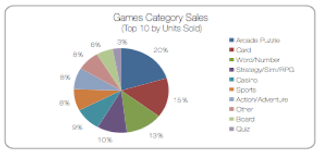
And here’s a chart of the game categories – and, no, still no first-person-shooters in the top 10:

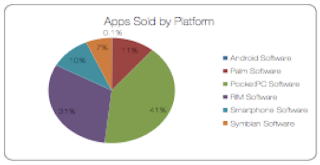
A noteworthy bit in the “Yardstick” is that Android already makes up for 10% of their sales (or so would the below graphic tell us). 

From this, it also occurs that Handango does not consider the iPhone to being very smart. Hm… Well, it’s probably that everyone who buys content on that one will buy not buy it from Handango but through the AppStore. OK then…

iPhone Mobile Entry Gate for Game Developers

Having just spent three incredibly inspiring days at Casual Connect Europe in beautiful Hamburg, there were – in respect of mobile games – two observations to be made: 1) the horror online and PC game developers express when looking at the fragmented space and the resulting “crazy” (quote) business models and 2) the iPhone is different, from a developer perspective this time.

Many, many developers of PC and Mac-based games (be it downloadable, online, browser-based) look at the iPhone as an entry gate to mobile gaming. A lot of the developers I spoke with were interested to work with a specialist mobile games company with a view to bringing their content across to the mobile platform but would not consider including the iPhone in this: “We’ll do iPhone ourselves. It’s a pretty easy platform to work towards and we understand the distribution model.”
This is likely to mean that there will be an ever-growing influx of games from reputable and experienced game companies onto the iPhone, and this might just increase the gap between Apple’s hit phone and the “rest” in content terms even more. Today, there are c. 4,500 games available for the iPhone (or so I hear; and remember that this is a mere 7 months or so after the AppStore launched), and a lot of providers are still missing on there. Whereas “traditional” mobile games have very high barriers to entry because of the complex (and hence expensive) landscape that one needs to address (hundreds of handsets, hundreds of distribution deals all to be struck with very big, often slow-moving “old-school” companies), none of this exists for the iPhone: Apple provides a simple agreement, there is one build to be delivered and one store where it is sold. Easy!
Irrespective of where the remainder of the mobile world will run (and they all seem to run now in order to catch up with the latest “Apple Revolution“), the AppStore is likely to become the first test case where game developers from different backgrounds (PC, online, etc vs. “traditional” mobile) will compete for customers directly. The former have a huge advantage in that they could leverage their online presence to promote the mobile version, too. This is only done by a few of the mobile “pure-plays” and it is tough to compete for eyeballs with an online games company that has 100m+ unique users per month. On the other hand, the mobile specialists have better knowledge about the specific mobile device constraints (which are very different to the ones on a PC).
Another interesting field to watch this year!

Page 11 of 16

Powered by WordPress & Theme by Anders Norén