Tag: mobile games Page 11 of 17

Barcelona, here we come…

Judging by the many Twitter updates today, I seem to be the last one to arrive at Mobile World Congress tomorrow: everyone appears to being already in the midst of networking, hunting for new revelations and, well, parties and tapas.

I’ll be setting off tomorrow morning at the break of dawn, so if you would like to meet up, drop me a line. E-mail will be safest as the show is traditionally one of the most frantic ones. Try me at volker [dot] hirsch [at] gmail [dot] com.
If you’re into gaming and all things mobile entertainment, you might want to check into the Mobile Backstage event on Thursday. I will be contributing on a panel on next generation gaming. But there will also be proper celebrities around with will.i.am and Kevin Spacey headlining the music and film sections…
And then I’ll be back next weekend with hopefully interesting learnings to share! Adios!

Top 10 Smartphone Games & Apps 2008

Smartphone content vendor Handango releases a smartphone “yardstick” every year containing the top sellers from data in their store. Anecdotally, smartphone apps are more often sold via direct stores (rather than operator decks) than “normal” (not smart?) phones, owing of course to the better connectability (not necessarily connectivity) of high-end phones: input mechanisms (Querty, touchscreen, better D-pads), almost always 3G phones, etc make for a more satisfying user experience (try inputting a web URL via a basic phone keypad… painful!).


They had just under 10,000 apps on offer (spread across Blackberry, Windows Mobile [pro and standard], Palm, Symbian and Android). The average price point was a rather healthy $19, and users downloaded 1.12 apps on average.

Handango also says that games rose as part of overall “top category” sales (whatever that is) from 11% in 2007 to 19% in 2008. This is encouraging. Even so, there is no game amongst their overall best-sellers for 2008. Here’s the list (price points at the end of each line):
1. Spb Mobile Shell 2.1.4 (today screen plug-in) – $29.95
2. MobiTV (streaming television) – $9.99/month
3. Ringtone Megaplex (ringtones) – $19.95
4. Spb Backup 2.0.1 (file backup) – $24.95
5. Spb Pocket Plus 4.0.2 (today screen plug-in) – $29.95
6. Pocket Informant 8 (today screen plug-in) – $29.95
7. Spb Phone Suite 1.3 (phone features) – $19.95
8. VoiceControl (voice command) – $6.00
9. Colour Your Trackball (trackball customizer) – $4.95
10. eWallet (Professional Edition) (PIM manager) – $29.95

The top 10 games across platforms for smartphones is this:

1. Spb Brain Evolution 1.2 (puzzle game)
2. Aces Texas Hold’em® – No Limit (card game)
3. TETRIS (puzzle game)
4. Guitar Hero 3 Mobile (music game)
5. Bejeweled (puzzle game)
6. Aces Solitaire Pack (card game)
7. The Sims 2 (strategy game)
8. Jewelrumble 2 (puzzle game)9. Sudoku Puzzle Pack (puzzle game)
10. Solitaire Buddy Gold (card game)

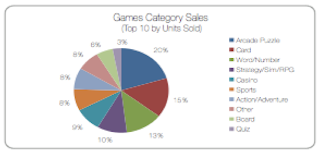
And here’s a chart of the game categories – and, no, still no first-person-shooters in the top 10:

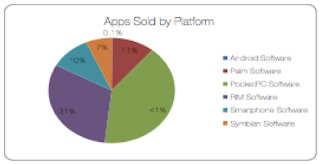
A noteworthy bit in the “Yardstick” is that Android already makes up for 10% of their sales (or so would the below graphic tell us). 

From this, it also occurs that Handango does not consider the iPhone to being very smart. Hm… Well, it’s probably that everyone who buys content on that one will buy not buy it from Handango but through the AppStore. OK then…

iPhone Mobile Entry Gate for Game Developers

Having just spent three incredibly inspiring days at Casual Connect Europe in beautiful Hamburg, there were – in respect of mobile games – two observations to be made: 1) the horror online and PC game developers express when looking at the fragmented space and the resulting “crazy” (quote) business models and 2) the iPhone is different, from a developer perspective this time.

Many, many developers of PC and Mac-based games (be it downloadable, online, browser-based) look at the iPhone as an entry gate to mobile gaming. A lot of the developers I spoke with were interested to work with a specialist mobile games company with a view to bringing their content across to the mobile platform but would not consider including the iPhone in this: “We’ll do iPhone ourselves. It’s a pretty easy platform to work towards and we understand the distribution model.”
This is likely to mean that there will be an ever-growing influx of games from reputable and experienced game companies onto the iPhone, and this might just increase the gap between Apple’s hit phone and the “rest” in content terms even more. Today, there are c. 4,500 games available for the iPhone (or so I hear; and remember that this is a mere 7 months or so after the AppStore launched), and a lot of providers are still missing on there. Whereas “traditional” mobile games have very high barriers to entry because of the complex (and hence expensive) landscape that one needs to address (hundreds of handsets, hundreds of distribution deals all to be struck with very big, often slow-moving “old-school” companies), none of this exists for the iPhone: Apple provides a simple agreement, there is one build to be delivered and one store where it is sold. Easy!
Irrespective of where the remainder of the mobile world will run (and they all seem to run now in order to catch up with the latest “Apple Revolution“), the AppStore is likely to become the first test case where game developers from different backgrounds (PC, online, etc vs. “traditional” mobile) will compete for customers directly. The former have a huge advantage in that they could leverage their online presence to promote the mobile version, too. This is only done by a few of the mobile “pure-plays” and it is tough to compete for eyeballs with an online games company that has 100m+ unique users per month. On the other hand, the mobile specialists have better knowledge about the specific mobile device constraints (which are very different to the ones on a PC).
Another interesting field to watch this year!

Mobile Social Gaming?!

I’ll be giving a presentation at Casual Connect Europe in a few weeks and have hence been looking a little at the concept of social gaming. In particular with the iPhone success story, this concept has received its fare share of the limelight recently – and rightly so: the unique distinguishing factor of a mobile phone is that it is always with its owner and that it’s always on, making it the perfect tool for connecting with people (well, this is what they were invented for in the first place), and the iPhone does that well not only with voice or SMS…

The “social” aspect of mobile gaming has mostly focussed on this connectivity and this is also what has been haunting it, at least in most parts of the world because of the horrendous fragmentation on the carrier and handset side. To make a fully integrated connected mobile game, one needs to integrate with a vast number of carriers (in the US, the situation is a little different – integration in only the 3 or 4 biggest carriers – Verizon Wireless, AT&T, Sprint/Nextel and maybe T-Mobile, and you’re in business big time; there is e.g. WPT Texas Hold’Em that scored tremendous commercial success, including full web-to-mobile-to-web play), and they cannot seem to resolve on a common standard; nearly every carrier runs its own little system…

However, do games really have to be fully connected multi-player with in-game chat, buddy lists, alerts, etc, etc, in order to be “social” games? I do not think so. They “merely” have to become a social object, and set in an environment to leverage the social aspect of this (there’s more from Jyri Engestrom on object-centered sociality). This does not work for every game in every case but there are plenty of examples out there both in mobile and online: Playfish (founded by mobile games veteran Kristian Segerstrale) runs a number of games on Facebook that are stand-alone single-player games but integrated into Facebook in a way that pushed them all the way up the rankings. Digital Chocolate runs a very successful franchise with TowerBloxx on mobile and online – again a single-player game with hooks into existing social networks (the latter providing the environment that facilitates them becoming a social object). Orange Israel recently created a raft of online destinations around Totomi: a micro-site, a Facebook Group is all you need to create a community around a game.
So whilst I am and will remain a big fan of connected games (phones are to connect with people!), some simple data streams out (high-scores, etc) AND links into existing social networks are actually likely to activate a lot of the potential in there. 
I will be continuing to ponder this, and I would be most grateful for any input!

Apple AppStore Rises and Rises: Now Past 500 Million Downloads!

It is quite breathtaking: it took them 3 months to hit 100m. Then, only 5 weeks after they announced that they went past 300 million downloads, Apple announced that they just raced past 500 million. This means 200 million downloads in 5 weeks, 40 million per week, 5.7 million per day or 4,000 per minute! Get that! Whilst numbers don’t equate to happiness, I sincerely hope that Steve Jobs will be taking some comfort from this and recover well.

I will not tire of harping about the (nigh) flawless end-to-end experience that enables that: a gaming experience that challenges “traditional” handheld gaming devices like Nintendo DS and Sony PSP, an interface that promotes games beyond the hardcore crowd, connectivity that allows “social gaming” to evolve (see also here), and a purchase experience that does not force a user through onerous double-digit-click orgies and various ominous warnings.
So despite the fact that we still do not have clearer numbers illuminating the underlying commercials of the average application and game on their, I tip my hat, I take a bow, I applaud…

iPod Touch mounts Handheld Gaming Challenge

A recent article discussed the rise and rise of the iPod Touch (that’s the iPhone without the phone). It apparently surged to the top of Amazon‘s sales charts, and mobile ad firm AdMob reports that ads served to the device more than tripled between November and December to 292m. This growth is said to even shadow growth of iPhone ads served and is being called, well, unprecedented. People are said to shun the forced marriage with AT&T’s long-term phone plan that come with the iPhone. Makes you think (if you’re an operator).

That’s all fine and dandy but I thought this was probably a good time to look at the iPod’s role as a handheld gaming device again. This was sparked by a remark from one of the Kleiner Perkins‘ chiefs (they’re the ones who set up the iFund, which invests exclusively into companies active in the iPhone/iPod Touch ecosphere) noting that the iPod Touch was now asserting itself as a more versatile alternative to the Nintendo DS or Sony’s PSP. This has of course been discussed for a while. The sales figures of the iPod Touch now seem to back these early (and initially largely theoretical) thoughts. 
Nintendo has been keenly aware of this even before the recently published app download numbers were out. In the words of the CEO of Nintendo US (from the above WSJ article):

“Whether you chose to play on your DS or listen to music on your iPod, we’re already in the same competitive space for time.”

And whilst one could argue about the pound-for-pound comparison of pure touchscreen vs devices with gamepads for certain types of games, the huge upside Apple has created is the hassle-free and easy distribution model for games: a DS developer needs to buy the cartridges (and pay for them up-front), find retailers, and then sell. This means huge cash outlay and very significant commercial risk over and above the development cost, making for a much less risky business model. And as to the input: some of the accelerometer-powered racing games are significantly better to control than with any game pad.

The DS is and arguably will be for a while a formidable gaming platform (as the father of a 10-year-old girl I can certainly vouch for that) but the sheer number of games available on the AppStore is likely to create a space longer term that may well tilt the balance in favour of the latter: you’ve got a) the arguably best music player in the market, b) higher WiFi usability (the DS doesn’t really allow you to surf the web), c) e-mail, maps, and all those nice little (and often useless) apps, d) much, much more choice of games at lower cost (anywhere from $0.99 to $9.99 as opposed to $30 for, say, Cooking Mama 2) and – to top it all of – e) the coolness factor of the sleek Apple form factor. Tough competitor, that.
For mobile games developers and new iPhone game entrants this constitutes and exciting development as it opens the revenue potential further up, and all that at a comparatively efficient and high-margin market place.

Silver Lining for Games…

… And a full-blown sunblast on Christmas Day, or so it would appear as per the latest PR from Try-and-Buy solution provider M-Biz Global. According to them, 2008 was a good year for mobile games (though I am not sure if the likes of MoConDi, Vivendi Mobile Games, Telcogames, Mighty Troglodytes, etc would agree). M-Biz’s numbers would rather suggest that the market may be shifting a little (or is re-focussing the better word?) towards pre-loaded trial versions of games. It is this segment that M-Biz is addressing, and it is therefore unsurprising that they saw downloads on Christmas Day soar to 6x (!) the average daily sales in the UK: a lot of people get new phones for Christmas and if something is on the handset already (a trial version), one is much more easily enticed into actually clicking that link.

All in all, M-Biz reports a 62% increase in revenue year-on-year, and a 21.29% and 50% increase in EMEA and the UK respectively in December 2008 compared to the average of the previous 11 months. All good! 

It tellies well with the findings open to see for everyone when looking at Apple’s AppStore: make the purchase process easy, make things transparent, and people will buy. The difference to both the AppStore and a pre-installed trial game is that it does not take the user 8+ clicks, a download, various cryptic messages (of the “this application is unsafe. Do you really want to install? Really, really, really?” ilk) to get gratification. I have mentioned on the Opinions on Mobile blog that I would expect this to be an area of focus for this year, and the numbers quoted by M-Biz would appear to being ample support of this.

Page 11 of 17

Powered by WordPress & Theme by Anders Norén