Tag: mobile games Page 10 of 17

Social Mobile Convergence in Gaming

At the European Mobile Media Conference earlier this week in Prague I gave this presentation on social mobile convergence in gaming, which I thought might contribute a little to de-mystifying this conundrum of buzzwords.

Have a look, tell me what you think…

Mobile Games on Twitter

Birds (sic!) do it, bees do it, even educated fleas do it, and now even Oprah (have you been there before her? Check here)… so: what about mobile games companies tweeting? Now, there’s many of them already out there (see list below) but how much sense does it make (that it makes sense for your business I demonstrated recently)?

Looking at a few of them, you’ll find anything from very 20th-century in-your-face selling (probably not so efficient) to enlisting (or trying to) followers to help in everything from game design, logo colours to community components that should go into the next iteration of the website. And it is in the crowdsourcing where I see a bit of potential: most mobile games companies are fairly small, and money to spend on sophisticated research, focus groups and what not is scarce or AWOL. If one can draw on the opinions and insights of friendly followers to learn about their (the consumers’) preferences, this is surely all good. Since Oprah is on there now, too, there is even a chance that your followers will not only be fellow industry professionals…
Although, even to the industry, Twitter is as powerful a tool to the mobile games people as to anything else (maybe with the exception of the global car-wash industry – everyone who’s been to CTIA Wireless will understand the reference): it is a great channel to get the message out to people who matter to you (and who actually show that they care by following you), which puts trade marketing (even if not in the strict sense of the word) onto the list on why you should do it.
So here’s a (surely incomplete – please excuse and feel free to add!) list of mobile games companies who tweet:
Gameloft: @gameloft
Connect 2 Media (yes, that’s us): @connect2media
Oasys Mobile: @oasysmobile
Hands-On Mobile: @handsonmobile
Digital Chocolate: @dchocgames
I-Play: @iplaymobile

Tag Games: @taggames
Fishlabs: @fishlabs
Gamevil: @gamevil
Distinctive Developments: @distinctivegame
Lemonquest: @lemonquest
Oh, and I’m out there as @vhirsch…

123 Play at Metro

123 Metro could be the name of the latest Major League Soccer franchise but it signifies a neat deal that 123Play, a service that wraps mobile games with ads free to end users, has just struck with the newspaper mavericks from Metro (they’re the guys with the free newspapers; see here for UK and here for the [seeming] inventors of the concept).

I like this deal a lot as it is so natural: Metro is a very successful advertising-driven medium and it ties in extremely well with 123Play’s model. Seamless, simple, very neat: anecdotally, a lot of people play games on their mobile when they have time to kill. Likewise, a lot of people read Metro when they have time to kill, namely when they commute on public transport. One challenge will of course be that there is no mobile reception in the London tube (or most other undergrounds for that matter) but the overall concept should work.
Disclosure: my company works with 123play.com (although I don’t think this post will bring me front-page coverage on Metro…).

iPhone all-time top 20 apps, countdown to 1bn downloads

I’ve been raving about it many a time and I still won’t stop but then: Apple does neither. When, waaaay back in January, I looked last, the App Store had raced through 500 million downloads and I calculated this to equate 4,000 per minute. Well, that’s history: We’re now through a 948 million total (count taken on 13 April, 11.23pm UK time from Apple’s site [check the little clock]) and look at 6,000 downloads per minute (or 100 every second of every minute of every hour of every day!) or so some learned friends have summed it up to.
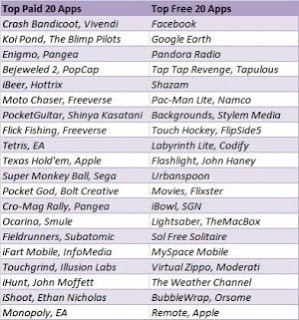
Apple also revealed a list of the top 20 all-time top downloads, both paid and free, which (courtesy of MoCoNews) is this:
So here’s the good stuff for my gaming friends: 14 out of the top 20 paid apps are games! Yes, baby! 6 out of the top 20 free ones are, too. Way to go! I haven’t looked at the pricing for the above paid apps but MoCoNews did: ¢99 is the prevailing price-point at the moment but $4.99 seems to be the price point of choice for “premium” games.

4G, LTE & Games: Casual On Speed!

Next to app stores (or markets or marketplaces or app worlds or, well, Ovi), the dominating theme of CTIA Wireless was 4G/LTE. Now, as sexy and de jour as app stores might be, the latter has a hugely larger commercial impact (the Verizon Wireless contract for their LTE network will be a multi-billion deal alone!). But what is a network without applications?

So it was just as well that, one day before CTIA Wireless, I had the great pleasure of contributing to the “Connecting the Consumer” panel at Alcatel-Lucent’s 4G Symposium (with Disney, Samsung, Buzznet and Atlantic Records all contributing, providing for the various facets of content [games, video/film, music, web]). The ground had been laid by the keynote of the formidable Mitch Singer, Sony Pictures CTO and a long-standing thought-leader in changing sectors (he’s one of the people who brought the original Napster down and – in his own words – “look was the music industry has become”). Mitch had reminded us of “The Innovator’s Dilemma” (Read it! It’s worth it!), which deals with how businesses should tackle change…

And this brings me to the nucleus of this post, which is how the content industry will (should?) approach the next big thing that is LTE.

By way of background: LTE (Long-Term Evolution; don’t ask why but this is apparently what it stands for) is largely seen as the successor to current third-generation (3G) networks (UMTS, WCDMA, HSDPA, HSUPA, CDMA2000, EVDO, call me if you want more acronyms…). LTE appears to have won the “fight” against Wi-Max (as some early commentators predicted) with carriers (Verizon Wireless, Vodafone and China Mobile amongst them) and vendors (Alcatel-Lucent, Ericsson, etc) strongly supporting it. The standard is capable of delivering speeds well in excess of 10MB/s over wireless networks. So, world, be prepared!
One of the obvious beneficiaries should be the games sector home of the tech-savvy early adopters: ultra-high broadband, super-speeds, fantastic opportunities. Or so they say…
The games market can probably – to this extent at least – be simplistically divided into a) hard-core and b) casual games. The former would comprise massively multi-player online games (MMO) as well as fast-paced, high-end racing and action games. The latter is, well, everything from Solitaire to Scrabble and Tetris. And, yes, the latter is the one genre played by far more people, including the online gaming industry’s “golden customer”, the proverbial 42-year-old housewife from Ohio (absolutely no offense meant, implied or indeed merited!). Whilst it is easy to see how a high-end action game would benefit from high bandwidth, the case may be slightly less obvious for the casual games space (on PCs alone, this is a $2.5bn+ market already today!).
Given the casual games’ higher adoption across a much broader demographic, it is however conceivable that carriers (the ultimate gate keepers for mobile content at least in the world as we currently know it) would want to reach that broader demographic: higher spending power than geeky kids, faithful, not necessarily wanting to change things every 5 minutes, predictable spending habits – this is a much safer and more promising target demographic than my 13-year-old son who will happily switch allegiance to a provider the moment another one has something cooler, cheaper, slightly funkier, whatever, … to offer.
So what can 4G do for the (mobile) casual games space? It brings, quite simply, wireless (or wire-free; remember that sweet tagline from Orange days long gone?) digital media to par with the wireline one (and will, in very large parts of the world, effectively be digital media (or do you think Brazil, China et al will dig up their vast countries to lay down copper or fibre cables to connect their non-urban consumers?).

So what, you say? Well, this allows consumers to actually play as they did before the arrival of the first crude iterations of the Internet, and that is socially: what was a game before computers and gaming consoles took over? An intrinsically social activity (cards, board games, petanque, golf, you name it). We have seen a huge uptake of social games on the Internet with tens of millions of consumers enjoying fairly simple games on Facebook and other platforms. And the next generation wireless will enable that again wherever you are (see here for a presentation I recently gave at Casual Connect in Hamburg on the topic).
So, high connectedness it is then! Games that will allow to interact with peers, friends, total strangers that happen to have the same passion for the same type of game around the world. Games become a social activity again. It is a less fancy, less futuristic vision than all-immersive high-end niche products such as World of Warcraft (which will also see its fair share of fame once the wireless networks can support it) but it is one that will finally make any wireless device as ubiquitous as many in the industrialized world (East or West) have learned wireline connected devices to be. And it actually takes some of the sting out of concerns that (digital) games will make video zombies out of our children.
This development (with LTE as the backbone) opens a market to be counted in billions rather than millions, and most of them will be wireless (the number of mobile phones outnumbers the number of Internet-connected PCs by a ratio of 2.5:1 already today!). And this is where the true market opportunity lies!

Apple's Gaming Platform

I wrote about this topic a couple of times already (here and here) but here‘s an interesting update/summary. The gist of the argument remains, only the numbers got better: Microsoft’s XBox has sold 29 million units, and that is fairly respectable (in particular when you consider that people regularly fork out $30 and more per game). Apple however (Mr Gates, I hate to say it) outsold its dear competitor by selling more than 30 million iPhones (and, well, iPod Touch).

The hardware install base is fairly similar then. There are two differentiators (besides the price point as per above and the fact that an XBox is not so portable nor meant to be): 1) Apple took a lot less time to get there, and 2) there are more than 25,000 applications for the iPhone, of which about 1/4 are games. That’s a lot!
And with its fairly awe-inspiring iPhone 3.0 update (more here or watch the entire keynote), one can now also add in-game micro-payments to the mix, which enhances the flexibility of billing models beyond anything its console or handheld rivals have on offer. Add to this the points raised in my earlier posts and the neat additions to the new iPhone SDK (use music stored on the device in the game, in-game voice chat, push notification waking up an app, stereo Bluetooth, etc, etc) and we are hopefully to see yet another wave of innovative, intelligent implementations of this. It is pretty cool indeed!

Mobile Internet is Reality!

A Nielsen survey commissioned (sic!) by backhaul specialists Tellabs found that the mobile Internet is pretty much a part of life nowadays – at least in the territories covered by this. They asked 50,000 consumers in EU5 (Germany, France, UK, Spain and Italy) and the US about their intentions with respect to 10 mobile data services. 

Italians are the quickest adopters, and Germans are slowest. 
The top 5 data services were (in order of ranking):  Mobile Internet, MMS (yes, really. I am skeptical, too), uploading photos, Software/app download (presumably includes games) and E-mail.

Here are some of the findings:

  • Mobile Internet usage will ignore the global recession and ramp up significantly in the next 12 months.
  • 71% of consumers anticipate daily use but concerns remain over – you guessed it – cost, speed and quality of service.
  • There are c. 200m mobile data users in the surveyed markets (which by my count equates to about 1/3 of the total population).  More than 50% of these users plan an increase of their usage in the next 2 years.
  • 25% of the users who do NOT currently use data services, plan to do so shortly (this would be another 100m).
This would all suggest that the recent signs of an accelerated move into smarter phones is actually being underpinned by the respective service use. Anecdotally, this was always known: the more sophisticated the handset, the higher consumption.
What is still worrying is the concerns over cost, etc. Carriers do move increasingly into flatrate data plans but their varying degrees of interpretation as to when a rate is flat (or rather what constitutes fair use) still leaves consumers cautious (and, frankly, as long as a few MB of data constitute the cap of fair use, this is likely to remain like this; not good…).
So all good! Even if Tellabs have a somewhat vested interest in this: they make their money with backhaul and service reliabity, a firm as reputed as Nielsen will not have cooked the numbers on this!   

Page 10 of 17

Powered by WordPress & Theme by Anders Norén