 Spotify was a breath of fresh air when it hit the markets. Finally, there was someone who combined the ease of iTunes with unsurpassed breadth in catalogue. Lots of songs. Always available. And even the ads weren’t all that bad (which is why few people upgraded to the ad-free premium version [more on this below], much to the dismay of label executives who – rightly – fail to see the greater good of dependable revenue streams from those few ads; although they are getting more, mind you).
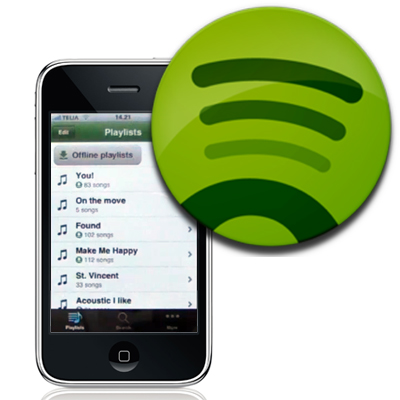
Then, back in July, Spotify submitted its iPhone app to Apple. And the big wait began. After lots of back and forth and speculation if it would or would not, Apple finally approved the app. So now it’s live, and not only on the app store (where it ranked #1 on the UK store when I checked tonight) but also on Android Market. A Symbian version is in the works.
All reviews I have read are raving: from “very impressed” (and that’s the Daily Telegraph no less) to having “to pry it out of my cold, dead iPhone” (Wired), everyone waxes lyrical about the thing. It comes with a load of stuff, too: streaming all your favourites from over 6m tracks on the go sounds promising, and one can also sync up to 3,333 (what a number!) songs for offline use in the networks’ broadband doldrums.
The trouble (!?) is: you can only use it as a premium subscriber, which means forking out £10 per month. Which brings me conveniently to the key point, which is the business underlying model.
 The labels are fairly happy, it seems. Because they got shares in Spotify itself. Some more equal than others though: the majors are said to have received a disproportionately high stake). The same report claims though that ad income is only £82,000 and, in the UK, only 17,000 users had signed up for the premium version. However, shareholders and all that, Spotify still has to pay the labels a fee per streamed track, irrespective of the user paying or not. Tricky model, that. Note though that this might be different in other countries: according to reports, the world’s largest major, Universal Music is making more money from Spotify in Sweden than from iTunes!
Anyhow, all this was before the mobile app, and mobile may well be the game-changer for them… The launch of the iPhone app, glorified niche audience or not, seems to have gone fairly well (#1 position on fhe app store within days of launch). Spotify reckons that mobile is where its future lies. And this had been echoed (and well ahead of the actual launch!!!) by others in the industry, and perhaps rightly so: if users are used to (and in love with) a service they are more likely to pay for it if that means they can also have it whilst on the road. For the marriage of music with the world’s leading MP3 player come mobile phone, the iPhone, this seems to be made in heaven: I can have the smallest model and still carry 6m+ tracks around with me? Wow! Here’s value-add!
 The much-discussed freemium model it is then: get them hooked on the free desktop app and convert them to paying users on mobile. It has long been known that users are more likely to pay if stuff is portable (I can still recall the disbelief of music executives when they realized that people would pay more for a monophonic ringtone than for a full-blown music track). And whilst now the link between (free) basic service on the desktop and (premium) mobile service is new, the principle is old and proven: and it is simply added value (plus the little things like being used to paying on mobile and having convenient existing billing models in place). If the user perception is that they are getting value for money, they are willing to pay. And if it is for such a fairly special thing such as music (don’t we all love and nurture our very own musical mix tastes?), the step is even easier to make.
Spotify fully expects this to fly: they are upgrading their servers already. Labels are said to be still a little jumpy but I reckon their experiences over the last decade or so have shown that their is a need to re-think incumbent models…

 On today’s is a stunningly beautiful Indian summer morning in England’s North-West and I have been indulging in the
  They’re coming… The big entertainment players are increasingly gearing up to take charge of their mobile destinies. Whereas previously a lot of the big movie studios would simply license out the rights to mobile applications and games to independent game companies (Gameloft and Glu having been particularly active), they seem to increasingly embrace the medium themselves. Sony, Disney, Paramount – they have all recently been self-publishing on the – erm – iPhone. Other mobile platforms? The 98% non-iPhone handsets? Erm, maybe later…
 The sales power of the Apple App Store is legendary with its 1bn+ downloads in record time. I have repeatedly held though that the other end of this ecosystem, i.e. the entry door to the app store (and related SDK and all) – and its relative ease of use – was an equally imporant contributor to Apple’s success. And now we have a