
 Droidcon is the first conference around the business and development environment for Android. The full programme is available here. It’s rolling right now in Berlin-Dahlem (Dahlem Cube). It will be followed by one of Mobile Zeitgeist‘s MZ Mixers, which kicks of tonight at 6pm (local) in the CSA Bar in central Berlin. Come around if you’re in the area. Should be cool!
Tag: mobile content Page 5 of 12
 Nokia’s N-Gage game service has just been declared dead, well dying anyway. always been a concept that has under-delivered painfully. In its first iteration, the device, it was a gutsy but maybe not entirely thought-through attempt to combine phone and dedicated handheld gaming device (it was always going to lose as one simply looked outright silly even when putting the thing towards ones ear to make a call – even when stood at a Star Trek convention, and that is telling). The “new” iteration, the software platform, struggled to take off. Nokia tried mightily to produce showcases demonstrating the superior gaming abilities of the platform compared to “regular” feature and smart phones but the efforts were thwarted from a number of angles:
Too expensive
It was a costly affair to deliver a game optimized for the N-Gage platform. When there is no proven distribution model that can guarantee decent returns, there would always be limited uptake from developers and publishers.
Too small a niche
N-Gage was always geared towards dedicated gamers. All marketing was directed this way, the positioning was distinctly high-end, no non-game applications were shown (or even contemplated, I guess). The power of the platform thus was funneled into a niche of a niche, i.e. high-end gaming. I would suggest that one could as easily have positioned it as a powerful media platform full stop. One that allows for beautiful execution of any number of simple or complex apps (and a game is basically “only” one app category).
There’s an app for that
 The iPhone then was arguably the final punch. In spite of developer frustrations growing over discoverability within this pile of 100,000+ apps, the platform has spurned exceptional games galore, and not only casual ones either. Real Racing is as punchy a racing title as one will ever get one on a handheld. And with people flogging to the app store in drones (rather than visiting it once to rarely if ever return), it appeared a less risky (and certainly more fashionable) move to leave it at that. Notably, Apple got the positioning piece (see above) right: even though it is a powerful gaming platform in its own right (anecdotally, the good folks at Firemint managed to string Real Racing to up to an impressive 82 fps), it never looked at this as a sole or even the main focus of the platform. There is a good reason why their already famous moniker says
there’s an app for that
rather than
there is a full 3D, 60+ fps, multi-player, high-end, Bluetooth and WiFi-enabled fighting game with dedicated combo mode for that.
And Mark Ollila, Nokia’s Director of X-Media Solutions and a games and general industry veteran, nails all of this down when he says that
One lesson is the complexities of offering rich games content on a global scale. […] How do you handle the billing, the local marketing intricacies and the type of gaming experiences that work in different markets? And what do consumers actually want – is it the high-end games with connected features that N-Gage was delivering, or a much broader catalogue?
At the heart of it is the conceptually different approach of monolithic, super-rich and highly integrated platform versus a more modular approach: in Apple’s app store ecosystem (or in Android’s for that matter), you can integrate most if not all of N-Gage’s features, too: multi-player gaming, communities, trial versions, etc. But you don’t have to. The former lacked flexibility, which made it susceptible to the nimbler, faster moves of a modular system.
 Well then. It at least gives Nokia the opportunity to focus solely on building out the Ovi platform and fix the bugs it has been plagued with at the start. Nokia clearly feels the pains of the rapidly changing market place and it struggles to adapt swiftly (which is – and one should appreciate this – much harder when you are running a product portfolio that has a market share of well double your nearest competitor and stretches all the way from the most basic feature phones to the most advanced smart phones) but it has people that should be capable to turn it around. Not easy, mind you but they’re a mighty player that has shown its ability to innovate numerous times, never forget that.
 A couple of weeks ago, I pondered Spotify’s impact on music business models and suggested that mobile may have a role to play in the monetization end of it (which is, unless you’re Twitter, an inherent part of a business model indeed). It didn’t take them long:
Today, the UK arm of 3 – always one of the more creative carriers – announced a handset (and not a bad one either) to be bundled with Spotify Premium (i.e. on the go and no ads): users will pay £99 up front, and then £35 a month for 24 months for a tariff including a Spotify Premium subscription covering both PC and mobile, 750 minutes voice calls, unlimited texts, data and Skype-to-Skype calls. Listen up: all bandwidth included. For a streaming service. Now we’re talking!
3 said that the Spotify Premium service was
worth £240
which suggests that they might want to stick to the £9.99 price point (which would surprise me). But then it is hard to tell which bit of such announcements is marketing and which actual price-setting for the sake of royalties and such like…
3 also said
that the deal with Spotify would extend to other products in the coming months, including 3’s mobile broadband service.
 Again, I am curious about the price point: the way it is, it would be a nice marketing deal for Spotify but it could be said that not much was going for taking exactly that offer vs just signing up as it is already. A little discounted however (with the difference paid for by 3’s marketing department) might change the ball game altogether…
It’s all good though: I for one am truly intrigued by the prospect of having more than 6 million tracks (equating to, what?, 6 terabyte or so of music) on my phone!
And one little thing on the side: it is – again – an app and not the mobile web that they choose – in spite of bandwidth apparently not being an issue at all. It is thus another argument for the superiority (for the time being) of apps over mobile web when it comes to UI and input constraints.
 Yesterday, I blogged about Motorola’s Motoblur UI, which adds an additional SDK for its specific APIs beyond the standard Android stacks. I reckoned that this might mean more fragmentation, which would push it a step closer to the nightmare that was/is J2ME.
I received two quick reactions to this: one reader commented that this was only bad if you wouldn’t have good tools and compilers. To him (@tederf), I would respond that, while it is certainly true that good tools reduce the friction, raise efficiencies and alleviate overall pain, the smallest common denominator is always just that. In my previous companies, we used to produce up to seven or eight different J2ME builds in order to maximise performance of our games on the huge spread of handsets. Could we have done with one build? Probably. Would the result have been great? Almost certainly not!
Anyway, the more interesting reaction came from the good folks at Motorola themselves. They reckoned (via Twitter; they are @motoblur) that:
with all due respect, I feel you’ve misunderstood motoblur, and android fragmentation concerns are a wee bit overblown.
Now, now. I offered them a guest post here in order to explain this further. I have unfortunately not yet had a response (which I take, applying Twitter attention spans, as lasting silence). But I still wanted to use the opportunity to elaborate a little more on this (and, no, I will not lament Moto’s lost opportunity to feature their wares on this humble site).
 To clarify a couple of things outright:
- I would be delighted would I be mistaken (and note that I am not a techie, so this is a distinct possibility!).
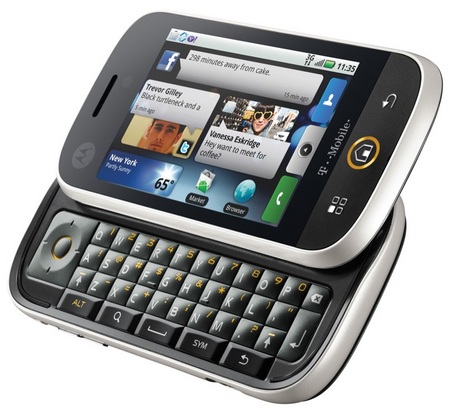
- I would be equally delighted would Motorola manage to regain some of its lost ground. The world clearly would be a better place with another strong manufacturer regaining old strengths (although maybe with better UI this time around – which Motoblur certainly seems to offer [see picture on the right of the Motorola CLIQ!).
But let’s go back to the general issue of Android fragmentation threats (the fact that I pointed this out – again – en cas de Moto is of course purely coincidental).
So let’s dive in: with open source software, there is always the intrinsic possibility that fragmentation will occur. Why do people customize it? Because they can! vendors, developers and operators that make up the Open Handset Alliance (which releases Android) can tweak is in whichever way they like (or “need” to) and for any number of reasons: to protect IP, to optimize performance on their network or for certain devices or simply because they feel they need some distinguishing factors, some degree of uniqueness. The result can be, however, as one analyst puts it that
there will be multiple flavors of Android, all of them incompatible with each other. That, in turn, necessitates different versions of each application or updates to accommodate the entire device ecosystem. On the whole, such activity negates the cost efficiencies inherent in the idea of a standard, open operating system, and potentially makes the Android Market a confusing place to shop for widgets.
And that’s what you call fragmentation. Interestingly, there were rumours that Google had made the Open Handset Alliance members sign “non-fragmentation agreements” but it seems that this is either not true or not enforceable.
Others point out that HTC, Samsung, Dell, Verizon, (may I add Motorola?) all have phones on the way that run on different software to the others. Reports of version conflicts, lack of backward compatibility, etc, etc. I mean, hell, there is even an “alternative” Android app store (with 223 apps as of tonight)… Sounds familiar?
Dear Motoblur, if it is different with your SDK, please enlighten us! I am sure I will not be the only one applauding!
Image Credit: http://www.visionmobile.com
 Here’s a nice deal: smartphone content specialist Handmark integrates Amazon’s new mobile payments service into its mobile content stores. This includes, most notably, also the famed (and sometimes damned) 1-Click functionality whereby users can (just like on iTunes; Apple licenses the 1-Click patent) buy content with just one click. The store will then use whichever credit card they have previously entered. To mobile users, bruised and tired of multiple clicks and onerous navigation to purchase a single piece of content, this is a true piece of added value (and one that was often hailed on Apple’s benchmark app store).
 From what I can see, Apple still leads in the fewest number of clicks but Amazon’s offering comes relatively close. Amazon’s service seems to offer a wider range of functions though: a user can pay, reserve, settle, run refunds, cancel, etc, etc, and, last but not least, a fairly established and recognized dispute resolution system, all through the Amazon API. Rather neat indeed! The transaction fees then are a dream for every mobile content provider: in the ranges customary for mobile content ($0.99-9.99), the fees range from 1.5%+$0.01 for Amazon Payments balance transfers to 5%+$0.05 for credit card payments. This, dear carriers, equates to a revenue share to the provider of 90-95%!
We will arguably see a whole range of app store providers taking this model up, in particular amongst those without a prior billing relationship. Carriers might be tempted to license the model, too, in order to facilitate the order flow (although I doubt that they will adapt the revenue shares, too): I would be surprised if Amazon could not adapt the back-end to integrate with a carrier’s billing module (although those commercial discussions would surely be interesting…).
It is a compelling case of transferring an existing brand with proven ease of use to the mobile web (where it will thrive first) and app stores the world over.
 With smart phones, app stores and the likes being all the hype, some of the commercially more successful mobile entertainment companies over the past several years tend to be, well, maybe not forgotten but dropping out of the limelight. I am talking about direct-to-consumer (D2C) providers.
Mobile D2C has been a much-maligned segment: Jamba/Jamster (now Fox Mobile), Zed, Buongiorno (or rather its Blinko consumer brand), Thumbplay, Playphone, and then the ones that have been gobbled up by competitors or fallen by the wayside over time such as Movilisto, Jippii, Monstermob, I-Touch, etc, etc. And the bad name was, at times, fully justified. Various subscription scandals, resulting class actions, general discomfort by consumers on how to handle this new type of service offering (and how to get rid of it again), they’ve had it all.
But what they also have is a real business. Just about the only awe-inspiring numbers the mobile content space has seen came from D2C players: whereas numbers are – as usual – a little hard to come by, Zed had previously been reporting monster revenues, Thumbplay is said to be the US market leader and grew from 2007 to 2008 by a cool 275%, Jamba was past the $600m mark already back in 2005 (I do not have more current numbers).
 There are companies however that tower over much, much better known mobile entertainment companies but largely escape the hype, and one of them is SendMe Mobile. Their founder & CEO Russ Klein recently revealed the company’s revenues, which are a not too shabby $10m — per month — and looking to ramp up for a cool $150m p.a. by the end of this year! So Russ’ company, which was founded only in 2006 and which deals with the relatively mundane end of mobile content outsells probably the vast majority of mobile entertainment firms on the planet. So who has heard of them? Many, many of their customers, I suppose.
SendMe has raised around $35m in venture capital to get here and doesn’t expect to needing anymore. SendMe also runs a mobile social community (MBuzzy) and has a reverse-auction service (SoLow). And that’s it. Easy, huh? I tip my hat, Mr Klein!
 After many rumours and ominous statements that it was “reviewing its activities” Namco Bandai confirmed today that EA Mobile will thenceforth act as its distributor for mobile games outside the US and outside any app store.
After Taito and Eidos, EA Mobile just gobbled up another major distribution deal and the exodus from J2ME games distributed via carriers continues. It also means that EA’s dominance over the operator decks has just increased a little more yet again. It had estimated (back in June) that its 2009 mobile revenues would reach $185m (although this arguably includes Apple’s and other people’s app stores as well as embeds).
 What is worrying is that this cements the oligopoly of games distribution in all major markets. EA Mobile, Gameloft occupy the top 2 slots very comfortably with Glu an equally comfortable but distant third. I-Play, Digital Chocolate, Real and Connect 2 Media are fighting for place and Xendex, Handy Games and a few others seek (and sometimes find) niches to prosper. THQ Wireless, Vivendi Games Mobile have departed. Player X found a new home under the mighty wings of Zed. And then? If the above companies all manage to maintain a healthy business, this might be enough; there are silverback gorillas in every market segment. If not though, this might become a doomed sub-sector; the limelight would then be on the (failed) ecosystem operators tried to build: overly fragmented with everyone of them wanting it just so and just their way rather than agreeing on a largely unified structure and processes pressed margins from a system that has been tough from the outset (handset fragmentation and international spread mean fairly high cost per capita anyway).
The accumulation of external properties arguably also mean that EA will need to run a business that is almost a combination of a publisher and an aggregator (with its very own challenges). The issue of shelf position (will they give Tetris and the Sims undue preference over Space Invaders, Pac-Man and Cooking Mama?), the commercials of their own deals (they anecdotally paid Hasbro a handsome sum), and the generally dominant position will all come into play and it is inconceivable (well, is it really?) that their partners will continue to play ball.
 It might of course only be a brief interregnum on the way to an app store world. Smartphones are very much on the rise and, in that world, such stores seem to rule. Apple has taken the lead, Android followed suit and new stores are springing up almost by the day, which also includes operator-led ones: Orange already has one, Verizon Wireless has announced one (mobile web-based) and so has Vodafone (which might actually be bigger than Apples) as well as many others. The OEM all do the same (even though some carriers want to disallow them): Nokia Ovi, Blackberry App World, Sony Ericsson, LG, Samsung, you name them, they have it. The question of course is if that might mean the same thing all over again: will they again want it all just so? Will they again have it just their way so that a user would have the unique flavour of operator X on handset Y in this unique way, meaning that – again – thousands of SKUs would be required to service them? Groundhog Day? I hope not!
Image credit: http://www.antitrustreview.com/files/2007/07/files51lsaydhrsl.-ss500-.jpg