Tag: mobile advertising Page 4 of 6

Carnival of the Mobilists #194

Ahead of CTIA later this week, this edition of the Carnival of the Mobilists is being hosted by Tsahi Levent-Levi on his VoIP Survivor blog. This week brings an incredible line-up of topics and contributors: A couple of posts on mobile advertising (including mine pleading for engagement as a crucial factor of ad success), the ideal app store, mobile learning and a whole host on the use of mobile apps in the workplace (including one with a Blackberry in a bakery!) and corporate environment in general plus a look on service and feature requirements for mobile phones in the developing world.

All very good indeed! So head over and set aside a good hour to read! You’ll find it here.

The Future of Advertising is in Engagement!

A lot is being said about mobile marketing, mobile advertising, capturing “consumer’s” imagination (if not only their eyeballs). And everyone says: “yes, I get that, social, mobile, always-on, always with them, cool!” Online ad spend outstrips TV already (at least in the UK), and mobile is arguably the next big thing; it is so much cooler, too: personal, accessible, always-on!).

So how do you execute? Banner ads? Text ads? Virals? “Ah, yes, virals are cool, I heard about them!”

There’s a busload full of mobile advertising networks out there, blind, premium blind, premium (check here for a great overview). And what do they do? Well, banner ads, text ads, the usual. Does it work? Anecdotally, sort of… Most developers and publishers I know that engage in this sort of activity make their money in two ways: either they are being commissioned by an advertiser to do it (good because you’re being paid!) or they use it as complementary (sic!) revenue; on a stand-alone basis, it would not feed them.

Why is the conversion not soaring? After all, mobile allows for unprecedented targeting (IF you do it. See here how not to do it): users have their phones always with them, it is always on, you can fall back on historical behaviours, etc, etc.

I would posit that it is because most advertisers still think of it in terms of consumers: beings that sit on the other (sic!) end of the message and who consume whatever I, advertiser, want to tell them. It is not, alas, true engagement, and this is where arguably the future lies.

So how do you engage? Many options. A good one is by being sincere (Zappos, the online shoe retailer that was recently acquired by Amazon, is a great example). Another one is by engaging rather than preaching. Not so easily done with banners. Easier done with something more interactive. Such as – an example – games and apps. On Apple’s app store, there are some great successes for this type of thing: German car manufacturers seem to be good at this! Audi did one, German developer Fishlabs did a couple of games for Volkswagen, Artificial Life for BMW, and then there is Waterslide Extreme, which is basically a Barclaycard ad (and badly executed: they could so easily have accommodated the RFID function, which the original cinema and TV ad is meant to promote; alas, they ignored it!) which despite its shortfalls was incredibly successful. But these are exceptions to what I think might well become the rule. On the app side, there are e.g. Pizza Hut and Gap that were recently featured (for free!) in Apple ads. Wow!

It seems obvious when you think about it: games truly engage (users – not consumers! – interact with them actively) and they can do so in a much more subtle manner (less invasive). At the same time, the user (not: consumer) spends a lot more time with the brand than with a banner ad.

It is, alas, a space of unknown dangers and unprecedented adventure: never-before seen creatures (scil. formats) and strange folks (scil. developers) roam weird landscapes (scil. mobile platforms). This is how brands and their agencies often experience mobile. They "get" it, don’t get me wrong but they are still fairly unfamiliar with it. And because the big pots of gold sit with the brands and they don’t want to risk cutting access, they’ll rather (and rather too often) stick with what they perceive as the trusted old paths. It’s not so good then that the freshest fruit grows on the trees in this new land and no longer in the wastelands of banner ads…

Watch this space then. It will only be a question of time (I hope) before we’ll be seeing a new wave of non-intrusive, interactive, fun brand engagement. And games and apps will lead the way!

US Mobile Advertising Snapshot August 2009

I had covered the monthly Scorecard for Mobile Advertising Reach and Targeting (what a mouthful) from Millenial Media before (see here for the May figures), so here’s an update on this (and note that these are all US-only figures). The firm covers just under 50m users, which seemingly represents 79% of the mobile web (but only 11 of the top 25 sites as per Nielsen). However, it should provide for a very decent overview of the state of advertising on the mobile web. So here it goes:

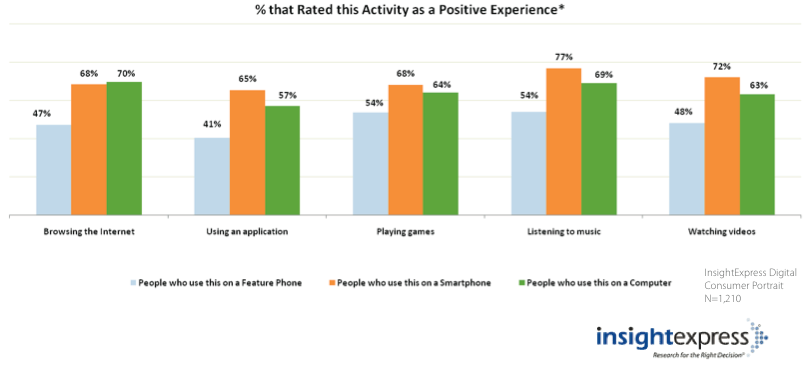
The first really noteworthy piece has not actually anything to do with advertising but with user satisfaction: would you actually have thought that users enjoy most things more when done on their smartphone than on their computer, including playing games and watching video? The computer only leads (and by a meager 2% higher rates) for web browsing (70% vs 68% on smartphones). Wow! Here’s the graph:

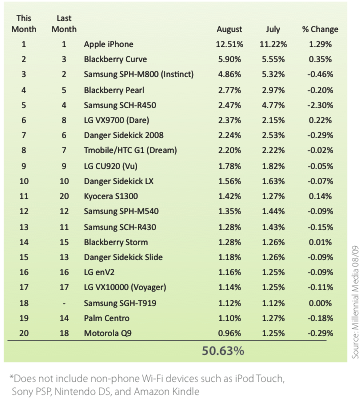
This is very encouraging and probably also owed to the market leader when it comes to ad impressions received on a mobile device, which is – moan – the iPhone of course. The last snapshot I covered had the Samsung Instinct in front but this has slipped back to a still respectable #3 now. Blackberry’s Curve takes 2nd place. Here’s the top 20 list:

Compared to their old format, Millenial Media is no longer spitting out a comprehensive chart showing the CPEU (cost per engaged user) per demographic/targeting method. They have adopted their proprietary “Mydas” tool, which appears to enable them to mix things together in an optimal way. It is understandable since this is their business but the look under the bonnet was great. Alas, no more. So here’s what we still learn:

  • iPhone and iPod Touch impressions are still growing with double-digit numbers (month on month they grew 68% in June, 29% in July and 15% in August).
  • Average monthly page views is 111 (up 5 views).
  • The top 20 phones (see above) make for 50.63% of all device traffic, which is drop by nearly 4% compared to the previous month.
  • A whopping 26.15% of all ad impressions were achieved on devices on a WiFi connection (bandwidth is king!).
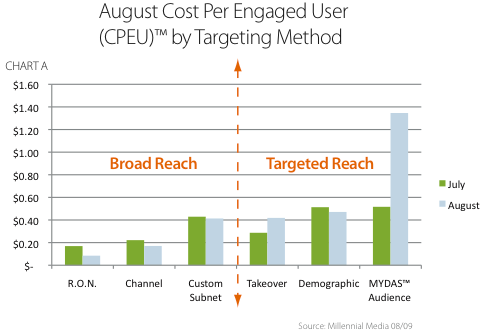
  • Cost per Engaged User for audience targeting increased very significantly from ¢52 to $1.35, which is owing to Millenial’s aforementioned Mydas thing (or so they say). Most CPEU rates decreased however. Here’s the chart:

So what does it teach us? Well, due to the new format unfortunately less than previously… but then: I’d love to have that Mydas touch… 😉

Fishlabs Slides to Advergaming Fame

Fishlabs, the German high-end 3D studio have long been one of my favourite developers (see here for a previous post). And with the ascent of the iPhone also appears to come the rapid rise to fame for them. Today, they have released numbers on one of their latest advergames, which they did for Barclaycard. For those not familiar: Barclaycard runs a large advertising campaign where a guy slides on a water slide through the city buying stuff whilst passing through markets, shops, etc. It took me a while to understand it (even though I am one of their customers) but it is to promote their new RFID-enabled credit cards.

Fishlabs produced an iPhone game for this (aptly called “Waterslide Extreme”). Interestingly, other than a Barclaycard logo on the main menu screen, I could not (yet) find any mention of the brand. Anyhow, Barclaycard seems to be super-happy as Fishlabs now has reported a whopping 2m downloads in one (!) week, which have generated 16m “engagement minutes”, presumably meaning that players engaged with the brand.

The – free – game is said to top the iPhone download charts in no less than 57 countries, including all the biggies like the US (where, reportedly, 54% of iPhone and iPod Touch users reside), the UK and Germany.

I just wonder if this is such good marketing (and I am not an advocate for unwanted in-your-face advertising at all): one mention of the brand (and very subtly, too) would surely make for only the most discrete of “engagements” with the brand.

So good on Fishlabs! But advertisers might want to consider giving these things a little more thought. Imagine the potential result for the image of the Barclaycard brand if, through a somewhat more thoughtful and smarter brand treatment, all of those 2m users would actually perceive it as a fun goodie brought to them by Barclaycard. Just to think of it… 😉

When Mobile Advertising Does NOT work

I have just been killing time and played a game on my iPhone. A free one. One with little ads at the bottom, mainly asking you to download all sorts of apps and games. Powered by Admob. And what do I get? An ad in Dutch asking me to download Skype. Then one in French offering me a free game. To make it clear: I am in the UK and had been playing on a UK-sourced iPhone with an O2 UK SIM card. I am a foreigner in this country but I am neither Dutch nor French; in fact, neither the Dutch nor the French usually like to be thrown into one pot with Germans… ;-).

Does anyone really think that this will work? And, moreover: what are ad “impressions” really worth when they only quite literally display, well, random stuff rather than ads people can also understand (for those unaware: being able to say “merci” with an even remotely foreign-sounding accent is considered a major linguistic accomplishment in this country)? In this context, AdMob’s recently reported numbers might be queried, I guess…

If advertising is to serve as a working alternative business model to paid downloads, then it is absolutely mandatory that advertising networks get their back-ends right. Depending on the ad model, simple ad fill might be enough for a publisher (if they are being paid by impressions; ECPM) but not if they are paid by click (CPC) but impressions of Dutch ads to Germans in the UK surely do not impress advertisers who are, after all, footing the bill!

I don’t know if this was a small glitch in AdMob’s systems or is more widely spread but I do hope it is the former.

AdMob on iPhone ad impressions and why Andrew Bud is wrong

Mobile advertising firm AdMob has released some numbers on ad impressions on iPhone vs other smart phones and the result is, well, that Apple is basically a 50kg flyweight boxer competing against Sumo wrestlers 5 times it weight (8% smartphone footprint but more than 40% ad impression share).

Now, very (!) crudely put, this does not mean that it is 8 times as successful on mobile advertising. It does mean however that users are 8 times more likely to use applications where ads are being displayed. Here’s some of their stats:

iPhone Apps (in AdMob’s network):

  • The top iPhone apps had more than one million users in the UK in May 2009
  • 5% of iPhone apps had more than 100,000 active users in May 2009
  • 14% of iPhone apps had between 10,000 – 100,000 active users in May 2009
  • 27% of iPhone apps had between 1,000 – 10,000 active users in May 2009

Mobile web browsing market in May 2009:

UK:

  • 48.7% of ad requests came from Apple handsets (iPhone and iPod Touch)
  • 28.4% of ad requests came from the iPhone
  • 282,493,761 ad requests from users in the UK

US:

  • 45.1% of ad requests came from Apple handsets
  • 25.7% of ad requests came from the iPhone
  • 3,804,373,544 ad requests from users in the US

Global:

  • 31.4% of ad requests came from Apple handsets
  • 18.6% of ad requests came from the iPhone
  • 7,997,946,483 ad requests from users around the world

Interestingly, MEF and MBlox Chairman Andrew Bud (who is being quoted at the end of the article) said that Apple’s app store compared to Nokia’s Ovi Store like a niche boutique to Tesco (or, if you are in the US, Walmart). Is that so? No it is not. And here’s why:

Apple is a boutique with more items on sale than a Tesco megastore. And its (less) customers buy trolleys full of wares. Moreover, their high-spending customers leave the store with a spring in their step and committed to come back the next day.

Nokia is a super-store with gazillion potential (!) customers where 1 in 20 stroll through aisles stocked with not so cool things and most of them walk out without buying anything and, on top of that, feeling fairly downtrodden and frustrated about what was on offer.

So, for the time being, I’d choose the Apple boutique. If that choice changes will depend on whether Nokia will manage to stock their shelves with more compelling wares and improve on their tills (less queuing, more bang for your buck, etc). Oh, and get those cold strip-lights replaced, please!

US Mobile Advertising Snapshot

The good folks of Millennial Media gave me a sneak preview of their May Scorecard for Mobile Advertising Reach and Targeting (yes, they call it SMART…), which looks at the US mobile advertising market, and then my daughter broke her arm and my blogging activities (and a lot of other things) took a time-out…

Anyway, Millennial reaches 73% of all mobile Internet sites (which they claim makes them biggest), which makes it a fairly comprehensive overview. And there is a lot of interesting data buried in this brief piece of research.

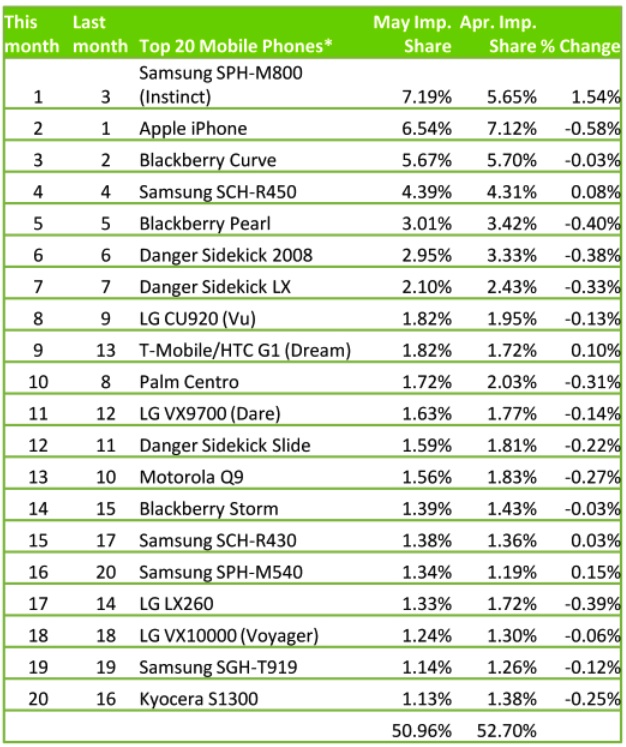
So, for May 2009, the handset on which most ad impressions were recorded was not the iPhone but the Samsung “Instinct” (otherwise known as the SPH-M800). The iPhone was on #2 ahead of the Blackberry Curve. A full list of the handset breakdown looks like this:

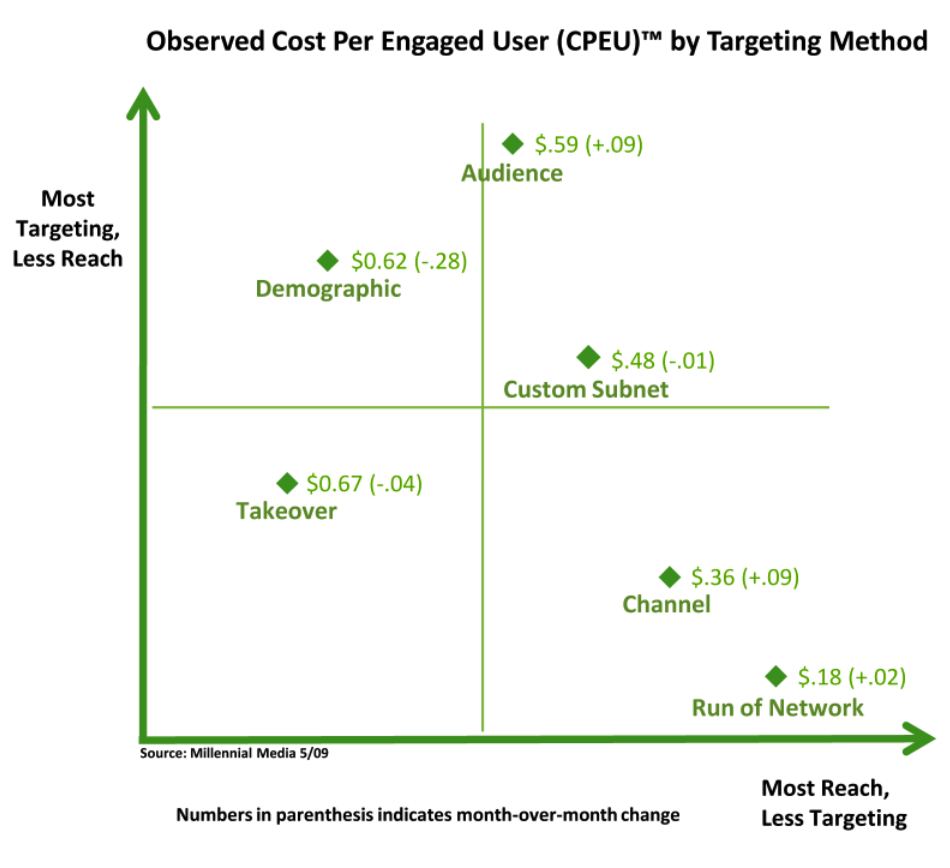
On the advertising front, we’re seeing some interesting metrics on cost per engaged user depending on the various measures included. Advertisers appear to be trying out a variety of approaches. Interestingly, the cost per engaged user for a campaign focused on a specific demographic has dropped very significantly (by ¢0.28 or c. 45%). Is this a sign of a higher take-up? Here’s a graph showing the details:

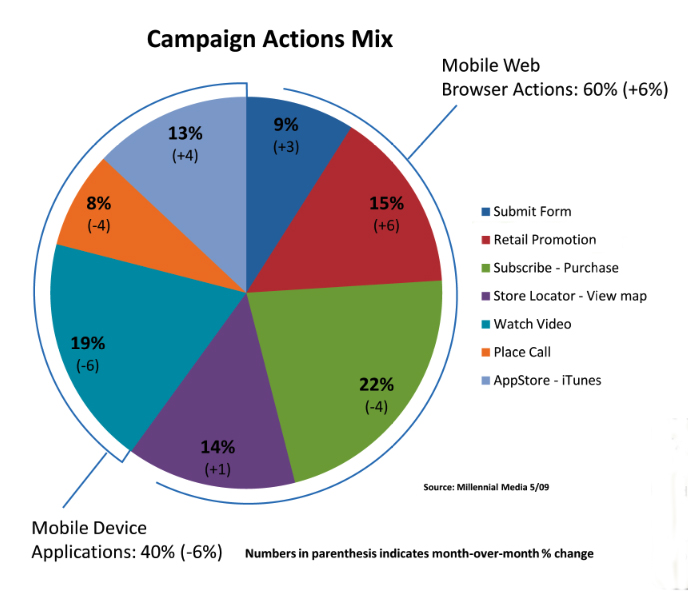
The mix of campaign activities is also interesting and shows that the sector seems to be coming of age. C. 60% of the campaigns (or committed budgets) were dedicated to the mobile web (browser) with the balance using some form of dedicated applications. The app store has its own category already and use of it (or rather iPhone apps) rose by 4 points to an overall 13% of campaigns, which is significantly higher than the iPhone’s footprint. However, I am sure more than 13% of art directors and their clients use iPhones, so maybe this is why. Or of course the iPhone could simply be a device (and the apps to go with it) that makes it easier to engage with users. Oh, what news… 😉 So here’s the final graph I’ll share with you, namely a chart showing the splits:

Page 4 of 6

Powered by WordPress & Theme by Anders Norén