Tag: Blackberry Page 8 of 10

RIM's 50m & Symbian's riposte

Blackberry maker RIM announced it had raced through the “epic” 50m device barrier. An honourable feat indeed! Symbian fired of a riposte (or was it Symbian-fan-boy-bloggers that did? I don’t know) that it had sold just under 80m devices in 2007 alone (with a total install base of 250m), and the Blackberry story therefore was to be considered as “how very quaint”.
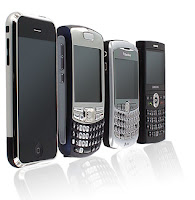
Now: isn’t this comparing apples and pairs? Every Blackberry is (and has been for, like, ever) the benchmark device for e-mail on the go. I still remember sitting in Moscow pulling down my e-mail on a Nokia 9300, and, in the time it took me to download the header of the e-mails when my dear US colleague had browsed through his e-mail and replied to 5. So: Symbian is not to be equated with Blackberry; it’s an entirely different thing: Symbian was all about creating a more powerful OS that could do a lot of things, and it does them fairly well. But we shouldn’t forget that most of them a N-Series devices without a QWERTY keyboard that do different things than a Blackberry does. It is probably possible (now, not 3 years ago) to create a similar experience on a Symbian-powered phone than it is on a Blackberry but I have still to find an e-mail client on a phone as pain-free, reliable and quick as the Blackberry’s.
I do believe that it is less about the theoretical power of an operating system but about the end-to-end experience (iPhone anyone? I commented on this a long time ago). And – across the board – a Blackberry beats most of its rivals hands down on that; still. So this comparison limps heavily. It is probably also to blame on this odd way to define “what is a smartphone“? The mere fact that it has a “an identifiable operating system” surely is not that smart (although Admob classifies it as such). 
I applaud RIM to their feat of selling 50m devices (or “i-banker phone” as they were called in their early years) and remain a fan.
On a sideline, RIM also mentioned that there have been 7m downloads of the Facebook client for the Blackberry so far. This would mean that a fairly respectable 15% of all Blackberries that have EVER been sold have the client, and this means that this is probably a rather high number of the ones currently in use. Who would have thought that? I-banker phone goes social networking. Ts ts ts…

Vodafone ponders and prepares to bulk up

Did you know about Vodafone’s Flipfont app? No, I didn’t think so; it seems to have gone more or less unnoticed. Well, it allows you to – listen to this – customise your phone frontpage. Woah! How cool is that? The downside? Well, you need to pay £1.99 for the pleasure, per screen! I don’t think so… And, apparently, (now) so does Vodafone. Amidst the iPhone/AppStore rage and the “revelation” that UI might actually matter to people, they seem to have realized that changing a font will not necessarily change the uptake of consumption to new levels. And because they cannot have the iPhone (although it has the Blackberry Storm, which is performing much better than the initial damning reviews would have suggested), they will launch their very own app store, or so they said (if you read Dutch, that is; how nice that we have a Dutch blogger amongst us who translated it for us).

This is not the only bit of news though: Vodafone also wants to tighten relationships with two other players in the market, and these are none other than giants China Mobile and Verizon Wireless. Now if you thought that Vodafone was large, take this in: together, these 3 carriers combine 821 million (!) subscribers (Vodafone 280m, China Mobile 457m and Verizon Wireless 84m [although I believe that VF counts a number of VZW subscribers proportionate to its shareholding in]).
Here’s what Vodafone’s CEO Vittorio Colao told the FT:
“If you think of three players, China Mobile is very strong in China; it’s a big country. Vodafone is very strong in Europe, Africa, India. Verizon is very strong in the US.

“If these three companies could work more closely… in the management of customers, procurement and service creation, we could be unbeatable, quite frankly.”
And right he is…

Finally: a new Palm

After bloody ages (and 425m Elevation dollars later) Palm came out with a bang yesterday at CES by unveiling the Pre and its new WebOS. Palm’s shareholders will be chuffed as the stock surged in the hours afterwards. Now, what is it? And does it have legs? One of the first reports (even containing a minute-by-minute live-blog of the presentation) notes that

‘its form factor is a blend of the HTC Touch and the iPhone. The software looks an awful, awful lot like that of the iPhone — multitouch, gestures and so on. Many of the apps also have a very strong likeness to the iPhone […].”

That in itself is of course not a bad thing. And other reports confirm high hardware quality and nice UI. However… Aren’t they a bit late? And where will the content come from? Palm used to have a faithful following on his Tungsten and Treo product lines but this is a while ago now and there have been some awesome devices in the interim, some of which – most notably the iPhone and the G1 as well as RIM‘s Blackberries and the higher-end Nokia devices – have amalgamated a great device with a great UI and commercial environment into a huge following. Apple AppStore, Android Market, N-Gage and Ovi, Blackberry Application Center, etc, are all there or there about. And Palm will be up against that. The fact that it has – at least initially – tied itself to Sprint only will not be much help there.
WebOS is said to be easy to develop for. Allegedly HTML, CSS and some other stuff known from the web would be enough to develop for it. But will anyone do it unless there is a device base large enough to make it a compelling commercial case (which even seems to hit platforms like Nokia’s N-Gage; THQ has just apparently dropped its “Worms World Party” development for this).
It’s nice to see they’re back but I think that the jury is still out on the success of this.

RIM eats Chalk

Blackberry maker Research in Motion is acquiring mobile content deployment solutions provider (quite a mouthful!) Chalk Media for $18.7m in cash. Chalk to what they call “pushcasts”, which – if I understand it correctly – is basically pushing podcasts to smartphones. The Vancouver-based company is listed on the Toronto Stock Exchange, so it still requires shareholder approval, and the deal is therefore not closed yet.

The move is a neat one: podcasts are increasingly used in the corporate environment for staff communications of all sorts, and the enterprise being the stronghold for RIM, it makes a lot of sense to strengthen its service offering by adding such a tool.
RIM has of course got under fire by Apple‘s iPhone and this will presumably continue being the case also by the higher-end Android-based phones who have been nibbling away (see here and here) on the Blackberry’s pedestal as the businessman’s (and woman’s) favourite gadget. A lot to defend then, and the price would therefore not seem to be excessive at all… Stringent rationale, me thinks…

Lower Handset Sales in 2009

The financial crisis will – what a surprise – also catch the handset manufacturers. A report tells us that handset sales are bound to fall in 2009, by 5.6% or 1.215 billion units, to be precise. The backend of 2008 already sees the impact, too: growth predictions have been reduced from 10.4% year-on-year to 8.9%.

This is in line with reports from Blackberry maker RIM who reduced its forecasts today. Even mighty Nokia is expected to lower its forecasts.
It can probably be expected that this will also impact the mobile content market: it is widely accepted that consumers tend to spend on mobile content in the first 3 months after they got a new phone. So: no new phone, no new content… Moreover: the above reduction in growth does not actually show the whole picture. Mobile content uptake is much higher on high-end phones. However, these are normally bought by way of upgrades, and it is there that the most severe drops are being predicted.

“While new subscriber additions are continuing at a healthy pace and are poised to grow by 563.9 million in 2008 and by 506.5 million in 2009, an overwhelming majority of the new subscribers are coming from the rural areas of emerging regions,” Teng said. “These subscribers primarily are purchasers of low-cost, entry-level handsets. However, the pricier feature-phone and smart-phone market segments are driven by existing subscribers who are upgrading their mobile devices to take advantage of new features and advanced data services. As the economic climate deteriorates, these customers are delaying their purchases.”

All doom and gloom then? Well, maybe not: others predict that the recession (at least in the US) will actually drive the number of wireless-only households. And, after all, a mobile game at €/$/£ 5.00 a pop is not the world, is it?

Google to be a force in mobile, too

More research predicting world domination for Google! Well, somehow anyway. According to a new report, Google will succeed with its expansion into mobile. Now, I thought they were there already and had been doing a bit of business there for a while: they’re the search engine of choice for quite a number of network operators already (although the jury is still out if this works: see e.g. here), and besides keep adding nifty apps to the mix (their mobile versions of Google Maps and Google Mail apps, well or at least for the Blackberry are pure bliss!). The latter are – for the time being – only an extension to their web apps without, notably, the ads; but this is only a question of time, I think: screen resolutions make AdWord a little awkward these days but higher resolution phone screens (such as for the new Blackberry Bold, which has widescreen QVGA) will likely change that. Google does offer AdSense for mobile already although there, too, no data on uptake or revenue is available (cf. press release).

On the carrier deck search side, I understand that this as well is more a question of land grab rather than actual revenues so far but the above applies, too. That is hearsay more than confirmed fact though.

Now, the aforementioned report thinks that Android-powered phones will grab 3% market share for smartphones in 2009 (corresponding to 8m devices). This is respectable. However, Apple’s iPhone is said to hold 17% of the global smartphone market and it is predicted to ship 45m iPhones in 2009. Shouldn’t Android phones be able to do more? I mean: Android is not only Google, it is also a gazillion other molochs of the mobile telecoms world (see e.g. here and here). Even if those numbers were right, they wouldn’t give Google world domination (remember Nokia? They hold some 40% of the world market…).

Then, say see local search being key, with which I agree. In their own words:

Local search will be key to market growth: innovations in mobile search and advertising will allow for improved local search, directly competing with ‘yellow pages’ type proximity marketing services. The challenge for Google is to encourage consumers to start performing functions on their mobile browser that they would previously have done on their PC in already established markets.

So: opportunity = local search and connecting this to Google’s fantastic capabilities in “normal” search. Threat = no uptake. I would add: getting local relevance and context right is not as easy as one should think (when I walk through London’s SoHo, do you think I am looking for media companies (Fox, Sony, etc.) or for Agent Provocateur?
I do think though that Google is indeed best positioned to get this one right: they solved the tough bit of the puzzle, and that is to sift through the vast arrays of the Internet to rank the “right” pages. To limit these to local relevant ones only, is surely “only” a question of adding another condition to your algorithms…
Also: the whole Android idea makes a lot of sense, and Google clearly has the lead in the Open Handset Alliance. So they “just” have to keep up with the innovative speed of the markets then… 
Note: I do not get paid by either Google or RIM (unfortunately) but I do use their services…

Page 8 of 10

Powered by WordPress & Theme by Anders Norén