Tag: Blackberry Page 7 of 10

Smartphone Market Shares & Growth

World market leader Nokia had a bruising 2008, at least in the smartphone field. According to a study, the Finns’ market share in this segment dropped by 10% to a – well – still fairly respectable 40.8% in Q4/2008 (as compared to 50.9% a for the quarter in the previous year). Painful!

The big winners were RIM (growth of 84.9% year-on-year), Apple (111.6%) and Samsung (138%) although the latter grew from a fairly low share (1.8%). HTC was up 20% but its carrier-branded handsets (T-Mobile G1, etc) were not listed under its own tab but under “others”, so there might actually have been more (probable when considering that the company’s profits rose sharply in Q4/2008 on G1 sales).
Apple, interestingly, is said to have suffered a fall of sales during Q4/2008 with growth in that quarter driven by the Blackberry Storm, T-Mobile G1 and strong Samsung sales. On the OS side, Windows Mobile made headway, mainly via the successful HTC Touch line and the Samsung Omnia.
Overall smartphone sales in Q4/2008 were 38m and 140m for the whole year. This seems to tie in roughly with the numbers I discussed earlier this month.
The changes are of interest to the content industry, too. Smartphones make for a disproportionate amount of content consumption, and smartphones also lead the way for the new app stores that are breaking through everywhere after Apple showed its competitors just how much consumers are craving content. RIM is out of the blocks, as is Android. Nokia announced its Ovi Store and runs similar programmes with N-Gage, NCD and Comes with Music already and Windows Mobile has just announced the shop it will launch itself. Remains to be seen where Palm will go with its Pre and WebOS: it only had 0.9% of the market (some faithful Treo users!) and hence lots of catching up to do. And what about the newly coined JavaFX?
Here are the charts (courtesy of Gartner via Cellular News) for 1) Q4 2008 by vendor, 2) all of 2008 by vendor, 3) Q4/2008: by operating system and 4) all of 2008 by OS:

Worldwide: Smartphone Sales to End Users by Vendor

(Thousands of Units)

Company 4Q08 Sales Market Share4Q08 (%) 4Q07 Sales Market Share4Q07 (%) 4Q07-4Q08 Growth (%)
Nokia 15,561.7 40.8% 18,703.3 50.9% -16.8%
RIM 7,442.6 19.5% 4,024.7 10.9% 84.9%
Apple 4,079.4 10.7% 1,928.3 5.2% 111.6%
HTC 1,631.7 4.3% 1,361.1 3.7% 19.9%
Samsung 1,598.2 4.2% 671.5 1.8% 138.0%
Others 7,829.7 20.5% 10,077.3 27.4% -22.3%
Total 38,143.3 100% 36,766.1 100% 3.7%

Worldwide: Smartphone Sales to End Users by Vendor, 2008

Company 2008 Sales Market Share 2008 2007 Sales Market Share 2007 Growth
2007-2008
Nokia 60,920.5 43.7% 60,465.0 49.4% 0.8%
RIM 23,149.0 16.6% 11,767.7 9.6% 96.7%
Apple 11,417.5 8.2% 3,302.6 2.7% 245.7%
HTC 5,895.4 4.2% 3,718.5 3.0% 58.5%
Sharp 5,234.2 3.8% 6,885.3 5.6% -24.0%
Others 32,671.4 23.5% 36,176.6 29.6% -9.7%
Total 139,287.9 100% 122,315.6 100% 13.9%

Worldwide: Smartphone Sales to End Users by Operating System, 4Q08

Company 4Q08 Sales Market Share 4Q08 4Q07 Sales Market Share 4Q07 Growth
4Q07-4Q08
Symbian 17,949.1 47.1% 22,902.5 62.3% -21.6%
RIM 7,442.6 19.5% 4,024.7 10.9% 84.9%
Windows Mobile 4,713.9 12.4% 4,374.4 11.9% 7.8%
Mac OS X 4,079.4 10.7% 1,928.3 5.2% 111.6%
Linux 3,194.9 8.4% 2,675.9 7.3% 19.4%
Palm OS 326.5 0.9% 449.1 1.2% -27.3%
Other OSs 436.9 1.1% 411.3 1.1% 6.2%
Total 38,143.3 100% 36,766.1 100% 3.7%

Note: The “Other OSs” category includes sales of Sharp Sidekick devices based on the Danger platform.

Worldwide: Smartphone Sales to End Users by Operating System, 2008

Company 2008 Sales Market Share 2008 2007 Sales Market Share 2007 Growth
2007-2008
Symbian 72,933.5 52.4% 77,684.0 63.5% -6.1%
RIM 23,149.0 16.6% 11,767.7 9.6% 96.7%
Windows Mobile 16,498.1 11.8% 14,698.0 12.0% 12.2%
Mac OS X 11,417.5 8.2% 3,302.6 2.7% 245.7%
Linux 11,262.9 8.1% 11,756.7 9.6% -4.2%
Palm OS 2,507.2 1.8% 1,762.7 1.4% 42.2%
Other OSs 1,519.7 1.1% 1,344.0 1.1% 13.1%
Total 139,287.9 100% 122,315.6 100% 13.9%

Note: The “Other OSs” category includes sales of Sharp Sidekick devices based on the Danger platform.
Top 10 Mobile Phones in February 2009

Here’s the list of the 10 best-selling phones (judged by accessory sales) as compiled by Krusell, our Swedish holster-maker friends. I will not comment further on the sense or nonsense of this information but reference what I said previously about it.

So without any further ado, here’s the list (in brackets the ranking from the previous month):
1. (1) Samsung SGH-i900/i910 Omnia
2. (2) HTC Touch HD
3. (5) Nokia 6300
4. (3) Nokia E51
5. (4) Blackberry Storm
6. (8) Nokia E71
7. (6) Nokia 3109
8. (-) Nokia 5800
9. (7) Sony Ericsson X1 Xperia
10. (-) Nokia 3120
The most noteworthy new entry is the Nokia 5800 (XpressMusic), and the holster-maker’s CEO reckons it would shake up the top 3 next month. After Nokia’s most recent US launch disaster (see even more poignantly here) for the device, this will sadly but almost certainly not be driven by US sales though…
And as for the remainder: I remain skeptical about the measure (holsters). Other surveys (based on sales, like Sound-Scan used to do for CDs) show VERY different results.

Blackberry App World Gets a Pal

Blackberry Maker RIM launched a holding site ahead of the launch of its Blackberry App World (the equivalent to Apple’s AppStore), and it had a little surprise in hand: billing appears to be handled via PayPal (the fine print does not need translation: “to be able to purchase applications from BlackBerry App World, a PayPal Account is required”).

This is two things: a) a massive win for PayPal and b) and nice move from Blackberry because PayPal is one of the simpler mechanisms, which will feel, like, so totally easy to many users (everyone who has tried to download applications and pay via credit card on their Blackberry will know how onerous it is/was).
I am thrilled to see this coming on. Apple has had 9 months free reign, and it’s about time that its competitors step up and bring commercial stores out. Blackberry will be fantastically suited as – due to e-mail having been its central USP – its users traditionally are on data plans anyway, and will therefore be less reluctant to dig in properly.

iPhone Dominates the Mobile Web (as yet)

The iPhone has a meagre 1.2% share of the overall phone market. However, it has true worker bees as users. No, honestly, these guys are sooo much busier than everybody else: they produce a whopping 2/3 of the world’s mobile web traffic, or so says a report. Yes, that’s right. Number 2? Shared between open-source-newbie Symbian and – remarkably – Android with 6.15% each, which is, erm, less than 10% of what the iPhone accounts for (and in spite there being a gazillion more Symbian-powered phones out there than iPhones). Next one in the queue then is Blackberry with 2.24%.

Interestingly, the researchers find that the runners-up are quickly gaining market share, which begs the question (again) if the iPhone was only a big marketing coup: did people only need the Jobs magic in order to be shown what they could actually do with their phones (and, yes, did operators need Mr Jobs vision to realize that fair use might exceed, like, 137 kb per month)?

The answer? No! 4,000 downloads per minute are more than a marketing fluke! That web traffic is not a mirage! What the iPhone did do is trigger a stampede towards better usability, better discovery, a better environment, more ease. It is no surprise that the Google-dominated Android phone is catching up so fast (in spite being the youngest platform): Google itself has a knack for simplicity and ease of use. And from the platforms that have been around for a little longer, Blackberry (traditionally equipped with flat-rate data plans and affluent users to go with it) and Symbian (highest install-base on smartphones) are best suited from the pack to catch up quickest. The only question is the one for Windows Mobile (ooh, and Mr & Mrs Gates children are not allowed iPhones…).
The most encouraging bit of that report is therefore not another staggering stat on the iPhone but that the others are catching up. A race to the top then (even if some say that, content-wise, it currently is a race to the bottom; I’m sure that that will sort itself out fairly quickly but of this another time…).

"Recession? Where?" Asks the Smartphone…

I previously looked at recession-busting sectors and products, and here’s more proof that not all is bad: two reports point out that smartphones continue to outperform the market rather significantly, recording growth figures of 25.9% year-on-year in Europe; the growth for all of 2007 vs 2008 was even more impressive: they grew by 36.1%. In the US, smartphones increased their share of the overall mobile phone market from 12% in Q4/2007 to 25% a year later. Good numbers!

Half of the (US) smartphones now come with touchscreens, with 70% “instead” (?) having a QWERTY keyboard (my best guess is that this includes phones with a slide-out keyboard, such as the T-Mobile G1 or the Sony Ericsson Xperia).

So how come? The iPhone but also other devices like Blackberries, Nokia’s higher-end phones (e.g. the N95) have powerfully demonstrated that the use of a mobile for things other than using voice and SMS (and take the occasional snap with a so-so camera) is not the end of all things. The overall feature sets of smartphones but – possibly more importantly still – the overall user experience is generally significantly better on a fairly comprehensive scale, and this – in particular in times of recession – would suggest a much higher value for money (“if I pay £50, then I get 4x in value of what I would otherwise have.”): they now all contain decent cameras, enough storage to work as a decent MP3 player (or in Apple’s case even as an iPod…), they do e-mail, connect more effortlessly to the Internet, play more fulfilling games and generally provide a much richer content experience (did I just hear “widgets”?).
For the content industry, this is good news: more powerful devices are generally easier to address and provide a better route to transport brands and production values across to the small screen. The iPhone has shown (see e.g. here and here) that users DO use their phones for all sorts of things if one makes it easy for them. Therefore, the smarter the phone, the higher the consumption. Good, good!

Top 10 Phones in the US, December 2008: the Ascent of the Smartphone

There’s new data out on the bestselling handsets, and this time it is not being derived from accessory sales (which may have its flaws as I pointed out here) but from a survey amongst service reps and store managers across the 4 big US mobile networks (Verizon Wireless, AT&T, Sprint Nextel and T-Mobile; these comprise 85% of the total subscriber base). Now, this would arguably reduce the recorded sales for the iPhone since this is also being sold via Apple’s own retail stores as well as Walmart, Best Buy, etc. So again not an entirely accurate yardstick, huh?

It is noteworthy that only one handset is available on more than one carrier (and, yes, it ranks prominently amongst the top 1) and that Nokia, despite all waiting, has still not managed to break the top 10.
It is also noteworthy that most of the handsets would certainly be classified at smartphones (the Samsung Rant might be the exception). And this is certainly good news. The T-610 and RAZR may finally have left the building…
So here we go (number in brackets is the previous month’s rank):
1. (1) Blackberry Curve
2. (2) iPhone
3. (3) Blackberry Storm
4. (6) LG Voyager
5. (4) LG Dare
6. (5) Blackberry Bold
7. (-) Samsung Rant
8. (9) Samsung Behold
9. (10) Samsung Instinct
10. (8) LG Env2
Source: Rankings are by Avian Research LL.C. (via the above link)

Top 10 Smartphone Games & Apps 2008

Smartphone content vendor Handango releases a smartphone “yardstick” every year containing the top sellers from data in their store. Anecdotally, smartphone apps are more often sold via direct stores (rather than operator decks) than “normal” (not smart?) phones, owing of course to the better connectability (not necessarily connectivity) of high-end phones: input mechanisms (Querty, touchscreen, better D-pads), almost always 3G phones, etc make for a more satisfying user experience (try inputting a web URL via a basic phone keypad… painful!).


They had just under 10,000 apps on offer (spread across Blackberry, Windows Mobile [pro and standard], Palm, Symbian and Android). The average price point was a rather healthy $19, and users downloaded 1.12 apps on average.

Handango also says that games rose as part of overall “top category” sales (whatever that is) from 11% in 2007 to 19% in 2008. This is encouraging. Even so, there is no game amongst their overall best-sellers for 2008. Here’s the list (price points at the end of each line):
1. Spb Mobile Shell 2.1.4 (today screen plug-in) – $29.95
2. MobiTV (streaming television) – $9.99/month
3. Ringtone Megaplex (ringtones) – $19.95
4. Spb Backup 2.0.1 (file backup) – $24.95
5. Spb Pocket Plus 4.0.2 (today screen plug-in) – $29.95
6. Pocket Informant 8 (today screen plug-in) – $29.95
7. Spb Phone Suite 1.3 (phone features) – $19.95
8. VoiceControl (voice command) – $6.00
9. Colour Your Trackball (trackball customizer) – $4.95
10. eWallet (Professional Edition) (PIM manager) – $29.95

The top 10 games across platforms for smartphones is this:

1. Spb Brain Evolution 1.2 (puzzle game)
2. Aces Texas Hold’em® – No Limit (card game)
3. TETRIS (puzzle game)
4. Guitar Hero 3 Mobile (music game)
5. Bejeweled (puzzle game)
6. Aces Solitaire Pack (card game)
7. The Sims 2 (strategy game)
8. Jewelrumble 2 (puzzle game)9. Sudoku Puzzle Pack (puzzle game)
10. Solitaire Buddy Gold (card game)

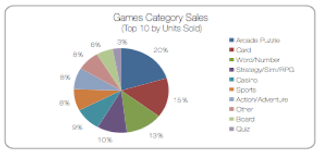
And here’s a chart of the game categories – and, no, still no first-person-shooters in the top 10:

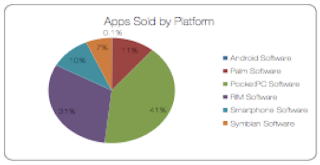
A noteworthy bit in the “Yardstick” is that Android already makes up for 10% of their sales (or so would the below graphic tell us). 

From this, it also occurs that Handango does not consider the iPhone to being very smart. Hm… Well, it’s probably that everyone who buys content on that one will buy not buy it from Handango but through the AppStore. OK then…

Page 7 of 10

Powered by WordPress & Theme by Anders Norén