Tag: Apple Page 11 of 17

Why an iPhone Deal with Verizon Wireless would be Cool

Today, interesting reports surfaced (or re-surfaced?) according to which Verizon Wireless and Apple are in discussions about bringing the iPhone to the former. However, because Verizon runs on a CDMA network and Apple has only ever supported GSM, commentators reckoned that this deal might be for Verizon’s next-generation LTE network. And this is when one can start dreaming…

To recap: Verizon will be amongst the (if not The) first tier-1 network operators rolling out the next generation of wireless networks under the LTE standard (see here for more on this). Under LTE, unprecedented wireless bandwidth will be available, comparable (or exceeding) what households in Western and Far-Eastern countries have in their homes today. But then you would have it of course wherever you are (well, if the respective technology is installed).
Due to the immense speeds, a lot of people think that the first big change will be on the (computer) broadband side of things: no need for wireline access if the speeds are the same and you can actually wander around and through town and always be with your provider. Simplicity, ease of use, bliss of connected life.

When it comes to mobile handsets (previously known as phones), the iPhone is of course (and despite the heckling by its many critics) arguably the most successful multimedia device known to man (so far). To marry this with these speeds? Ah, what would await us (see here for earlier thoughts). The iPhone (if they can fix the battery life) would be perfectly suited to bring the new lush wireless life to the masses (albeit first to the more affluent ones): rich graphics, innovative inputs and the fairly unique form factor would show the opportunities off rather beautifully and could hence aid to avoid the post-3G hangover where people asked themselves why on earth they should get 3G phones: there was nothing much to do with them (other than being able to make “faster” phone calls…).
The most common uses would arguably be music and apps with the latter being even more successful than the former: it is estimated that iTunes took 6 years to record 6.8 bn downloads; the App Store did 1 bn in only 9 months (or 1.3bn p.a.), which would equal 7.8 bn in 6 years if no further growth would occur. Anyway, with 1.1 bn downloads p.a. not being too shabby either, let’s take both, so what do we get?
On the music side, it would either mean quick and high-quality downloads or, more likely (?), streamed music. The same applies to the VOD and movie segments.
On the apps side, LTE would arguably push the envelope into two directions: (1) high-end, graphically rich games, and (2) ultra-connected social games that seamlessly bridge media platforms. Now: both types had their advent on the iPhone. Speak to any number of high-end games makers, and they will tell you that their life became much easier since the iPhone was there. Look at products like EA’s Scrabble (with full Facebook integration), Playfish‘s games (coming from the other end, i.e. from Facebook to iPhone), etc and you have the foundations laid here, too. With LTE, all this becomes mass-marketable to a much higher extent. And this would be real fun!

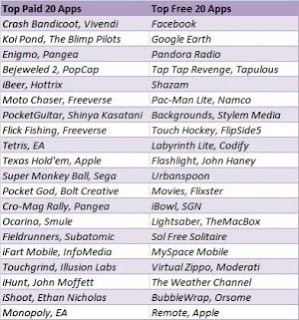
iPhone all-time top 20 apps, countdown to 1bn downloads

I’ve been raving about it many a time and I still won’t stop but then: Apple does neither. When, waaaay back in January, I looked last, the App Store had raced through 500 million downloads and I calculated this to equate 4,000 per minute. Well, that’s history: We’re now through a 948 million total (count taken on 13 April, 11.23pm UK time from Apple’s site [check the little clock]) and look at 6,000 downloads per minute (or 100 every second of every minute of every hour of every day!) or so some learned friends have summed it up to.
Apple also revealed a list of the top 20 all-time top downloads, both paid and free, which (courtesy of MoCoNews) is this:
So here’s the good stuff for my gaming friends: 14 out of the top 20 paid apps are games! Yes, baby! 6 out of the top 20 free ones are, too. Way to go! I haven’t looked at the pricing for the above paid apps but MoCoNews did: ยข99 is the prevailing price-point at the moment but $4.99 seems to be the price point of choice for “premium” games.

Carnival of the Mobilists #166

This week’s Carnival of the Mobilists is hosted by the formidable Caroline Lewko at WIP Jam. I am very happy to note that my latest post on Apple’s growing relevance as a gaming platform is included in last week’s line-up. For the remainder, there’s stuff on LiMo (for some background on where they came from see here) and some very worthwhile piece on mobile marketing amongst much more. And now go to read it here!

Apple's Gaming Platform

I wrote about this topic a couple of times already (here and here) but here‘s an interesting update/summary. The gist of the argument remains, only the numbers got better: Microsoft’s XBox has sold 29 million units, and that is fairly respectable (in particular when you consider that people regularly fork out $30 and more per game). Apple however (Mr Gates, I hate to say it) outsold its dear competitor by selling more than 30 million iPhones (and, well, iPod Touch).

The hardware install base is fairly similar then. There are two differentiators (besides the price point as per above and the fact that an XBox is not so portable nor meant to be): 1) Apple took a lot less time to get there, and 2) there are more than 25,000 applications for the iPhone, of which about 1/4 are games. That’s a lot!
And with its fairly awe-inspiring iPhone 3.0 update (more here or watch the entire keynote), one can now also add in-game micro-payments to the mix, which enhances the flexibility of billing models beyond anything its console or handheld rivals have on offer. Add to this the points raised in my earlier posts and the neat additions to the new iPhone SDK (use music stored on the device in the game, in-game voice chat, push notification waking up an app, stereo Bluetooth, etc, etc) and we are hopefully to see yet another wave of innovative, intelligent implementations of this. It is pretty cool indeed!

Games Pulsating Through One Platform?

Here’s one that nearly slipped through the (well, at least my) net: according to a recent press release, the Eclipse Foundation is set to unveil a unified development platform. It is said that some major players, including Nokia, RIM, Sony Ericsson, IBM and Motorola have joined this initiative already though Android and – predictably – Microsoft and Apple are notable in their absence.

The concept is oh so simple: a developer goes to the site, downloads the platform and is ready to rumble. The platform (called Pulsar) would pull together vendor-specific SDKs and off you go. It is clearly geared to tackle the fragmentation of the many, many handsets to be addressed when publishing to “mainstream” mobile phones.
At present, it’s an initiative (as there have been so many) and the presence of industry heavyweights does not always guarantee their success. I am (cynicism coming with age…) cautious over black box approaches (remember Tira Wireless?). I would love to see this succeed but let’s see what it comes to…
Image credit: digitalvish.com

Microsoft App Store Better than Apple!?

Microsoft has a central market place for Windows Mobile applications in the making. It is the latest (and maybe the last) of the big smartphone platform makers to come forth with such a model. And – with a probably already somewhat reflexive jab to its Cupertino nemesis (yes, Mr Gates’ children are not allowed iPods), it vowed to be more open to outside software developers.

Apple is indeed not known for the most proactive approach to external partners but it does have a bit of a name for being a “good company”. Microsoft on the other hand is, rightly or wrongly, not really known for this. It would be a nice move. Other than that – also somewhat familiar – Microsoft’s store is said to be closely following Apple’s lead, even the revenue share (70% to developers) is apparently the same. The only difference would then be the openness. This is presumably being highlighted following a couple of incidents where developers complained that Apple had not accepted their applications without giving them a good reason. If Microsoft were to make this bit better, it would constitute a significant improvement as it would save developers from spending money on application development only to see them canned.
The rationale for Microsoft’s move is utterly simple: a) there are more Windows Mobile apps out than iPhone ones (20,000 they say). It is just a wee bit more difficult to find them, b) everyone else (RIM, Nokia, Android, hell, even Palm) does it, and c) Apple is insanely successful with it.

The big question that remains is if the integration of the store will be as seamless as Apple’s. The key differentiator is that Apple has managed (which no other OEM has so far) to impose a strictly regulated environment from end to end: its program has an easy entry (a few paragraphs with a click-through agreement), a fairly well-controlled development environment and a unified output (the store), which is the same anywhere in the world. Even the biggest OEMs have struggled to impose anything even resembling this kind of control. Windows Mobile runs on a number of the tier-2 players (HTC) that have done the opposite to Apple: HTC willingly gives away its branding in favour of a carrier brand and is content to provide the hardware. Since it can be expected that at least the larger carriers will be keen to run app stores of their own, Microsoft will struggle more than Apple (which was a highly anticipated new market entrant with a tremendous brand message) to assert this type of dominance over carrier specs. The recent rumours of lower Windows Mobile output won’t necessarily help either.
I would welcome a success from Microsoft; let Apple not grow overly content…

Smartphone Market Shares & Growth

World market leader Nokia had a bruising 2008, at least in the smartphone field. According to a study, the Finns’ market share in this segment dropped by 10% to a – well – still fairly respectable 40.8% in Q4/2008 (as compared to 50.9% a for the quarter in the previous year). Painful!

The big winners were RIM (growth of 84.9% year-on-year), Apple (111.6%) and Samsung (138%) although the latter grew from a fairly low share (1.8%). HTC was up 20% but its carrier-branded handsets (T-Mobile G1, etc) were not listed under its own tab but under “others”, so there might actually have been more (probable when considering that the company’s profits rose sharply in Q4/2008 on G1 sales).
Apple, interestingly, is said to have suffered a fall of sales during Q4/2008 with growth in that quarter driven by the Blackberry Storm, T-Mobile G1 and strong Samsung sales. On the OS side, Windows Mobile made headway, mainly via the successful HTC Touch line and the Samsung Omnia.
Overall smartphone sales in Q4/2008 were 38m and 140m for the whole year. This seems to tie in roughly with the numbers I discussed earlier this month.
The changes are of interest to the content industry, too. Smartphones make for a disproportionate amount of content consumption, and smartphones also lead the way for the new app stores that are breaking through everywhere after Apple showed its competitors just how much consumers are craving content. RIM is out of the blocks, as is Android. Nokia announced its Ovi Store and runs similar programmes with N-Gage, NCD and Comes with Music already and Windows Mobile has just announced the shop it will launch itself. Remains to be seen where Palm will go with its Pre and WebOS: it only had 0.9% of the market (some faithful Treo users!) and hence lots of catching up to do. And what about the newly coined JavaFX?
Here are the charts (courtesy of Gartner via Cellular News) for 1) Q4 2008 by vendor, 2) all of 2008 by vendor, 3) Q4/2008: by operating system and 4) all of 2008 by OS:

Worldwide: Smartphone Sales to End Users by Vendor

(Thousands of Units)

Company 4Q08 Sales Market Share4Q08 (%) 4Q07 Sales Market Share4Q07 (%) 4Q07-4Q08 Growth (%)
Nokia 15,561.7 40.8% 18,703.3 50.9% -16.8%
RIM 7,442.6 19.5% 4,024.7 10.9% 84.9%
Apple 4,079.4 10.7% 1,928.3 5.2% 111.6%
HTC 1,631.7 4.3% 1,361.1 3.7% 19.9%
Samsung 1,598.2 4.2% 671.5 1.8% 138.0%
Others 7,829.7 20.5% 10,077.3 27.4% -22.3%
Total 38,143.3 100% 36,766.1 100% 3.7%

Worldwide: Smartphone Sales to End Users by Vendor, 2008

Company 2008 Sales Market Share 2008 2007 Sales Market Share 2007 Growth
2007-2008
Nokia 60,920.5 43.7% 60,465.0 49.4% 0.8%
RIM 23,149.0 16.6% 11,767.7 9.6% 96.7%
Apple 11,417.5 8.2% 3,302.6 2.7% 245.7%
HTC 5,895.4 4.2% 3,718.5 3.0% 58.5%
Sharp 5,234.2 3.8% 6,885.3 5.6% -24.0%
Others 32,671.4 23.5% 36,176.6 29.6% -9.7%
Total 139,287.9 100% 122,315.6 100% 13.9%

Worldwide: Smartphone Sales to End Users by Operating System, 4Q08

Company 4Q08 Sales Market Share 4Q08 4Q07 Sales Market Share 4Q07 Growth
4Q07-4Q08
Symbian 17,949.1 47.1% 22,902.5 62.3% -21.6%
RIM 7,442.6 19.5% 4,024.7 10.9% 84.9%
Windows Mobile 4,713.9 12.4% 4,374.4 11.9% 7.8%
Mac OS X 4,079.4 10.7% 1,928.3 5.2% 111.6%
Linux 3,194.9 8.4% 2,675.9 7.3% 19.4%
Palm OS 326.5 0.9% 449.1 1.2% -27.3%
Other OSs 436.9 1.1% 411.3 1.1% 6.2%
Total 38,143.3 100% 36,766.1 100% 3.7%

Note: The “Other OSs” category includes sales of Sharp Sidekick devices based on the Danger platform.

Worldwide: Smartphone Sales to End Users by Operating System, 2008

Company 2008 Sales Market Share 2008 2007 Sales Market Share 2007 Growth
2007-2008
Symbian 72,933.5 52.4% 77,684.0 63.5% -6.1%
RIM 23,149.0 16.6% 11,767.7 9.6% 96.7%
Windows Mobile 16,498.1 11.8% 14,698.0 12.0% 12.2%
Mac OS X 11,417.5 8.2% 3,302.6 2.7% 245.7%
Linux 11,262.9 8.1% 11,756.7 9.6% -4.2%
Palm OS 2,507.2 1.8% 1,762.7 1.4% 42.2%
Other OSs 1,519.7 1.1% 1,344.0 1.1% 13.1%
Total 139,287.9 100% 122,315.6 100% 13.9%

Note: The “Other OSs” category includes sales of Sharp Sidekick devices based on the Danger platform.

Page 11 of 17

Powered by WordPress & Theme by Anders Norén