Category: Thoughts

Book Review: “Delivering Happiness”

This is (slightly) off-topic as it looks at a new book written by a guy who has come to fame not in the mobile but “only” in the online world (or click-and-mortar as would be more accurate). But it is a book that will give everyone who has to deal with value chains, investors and people (vendors, customers, employees) a couple of interesting insights on how it can (also) be done.

The book, of which I received an advance free copy (which I was told I needed to disclose here), is by Tony Hsieh, the iconic CEO of Zappos, and it is called – unsurprising to anyone who has ever heard im talk – “Delivering Happiness”. It is available for sale from today.

The book has two very distinct parts. The first one gives you an interesting and humorous account of the journeys of an entrepreneur – all the way from a worm farm when ickle Tony was 8, via LinkExchange, which he managed to sell to Microsoft for $265m, through the start, near-death and eventual exit with Zappos, which sold to Amazon when it was valued at some $1.2bn on the day of closing.

Part 2 could be termed the introduction to the Church of Hsieh. Tony is famous for preaching the importance of happy employees in order to run a good business, and there is many an example from the world of Zappos that raises eyebrows elsewhere in the corporate world (to pay new employees $2,000 should they leave within X weeks being one of them). Most of it comes from one of the 10 core values Zappos set itself, namely the “be fun and a little weird”, and I find it almost insulting to judge a company or its policies by random examples alone.

At the very least, the book shows you that there is much more to it than the wacky ideas of a driven entrepreneur (and I’ll get to more in a moment). If you take, for instance, the story of the $2,000 leaving-bonus and look into it a little deeper, some very sound thinking reveals itself:

The idea is that people should only stay if they really feel aligned to Zappos’ vision and principles and the idea is that only people whose mindset is a real fit will not be tempted enough not to take it; it also shows a lot of respect to the nature and common sense of their employees: if the job [and the company] is really that good, $2,000 is very little! According to the book, less than 1% take the cheque.

So what do you get from that? 1) employees that should be a better fit than average, and 2) reduced recruitment cost. The first part is invaluable whenever you run a business that has customers (so, always) because employees that fit with your culture and vision should be better enabled to communicate this – internally and externally, which helps the business. The second part is self-explanatory.

The relentless focus on company culture is as awe-inspiring as it must be spooky to some. And it is, arguably, amongst the reasons for their sale to Amazon (or so VentureBeat interprets this part from the book). Sequoia pocketed $248m on $48m investment and were keen to liquidate (and, according to Hsieh, his board was not entirely convinced of “Tony’s social experiments”).

One should however not forget over this that Zappos operating principles are based on hard-nosed facts (from vendor relations, logistics, finance, employees to customer relations), and the “secret sauce” might then indeed be the company culture (Tony Hsieh is of course not the first one to propagate this). If he tried to take things too far is beyond me to say but I would say that a company that strives to make its customers, vendors and employees happy is not following a necessarily wrong path – even under cold-nosed corporate standards:

  • Happy customers will help you by coming back to you (low retention costs and follow-on revenue) and by recommending you to their friends (low acquisition costs and incremental revenue);
  • Happy vendors will be more likely to accommodate your requirements as to your stock (lower cost of supply), delivery schedules, etc, etc.;
  • Happy employees reduce your employee churn and will – arguably – provide for higher productivity of the company as such (lower operating cost).

It is, in short, a very worthwhile book to read. And if you read it with the right glasses on, you will be able to look through what might sound like the preachings of Hsieh to find some real benefits for your own company (whether it exists already or is in the formation stages in your mind only and whether it is mobile, online or good old brick and mortar). If you are then still a believer, check over here for more…

And if you want to buy it?

Buy “Delivering Happiness” here

The joy (and cost) of Freemium

The term “Freemium” has been coined first a while ago by Union Square Ventures founder Fred Wilson and has been articulated further by Chris Anderson of Wired fame in his book “Free”. It has since attracted significant interest, last but not least because the concept seems to work… 😉

Ngmoco goes Freemium

Yesterday, Ngmoco, one of the new world’s (scil. Apple App Store’s) giants announced it raised another chunk of money ($25m to be exact) and acquired Freeverse, an iPhone developer that recently announced it had sold (sic!) more than 5m games, which are, alas, not always free – in the contrary. Together with this, Ngmoco announced a push into the Freemium model. So there we are…

To recap: the company had released two titles so far under the Freemium model, namely Eliminate Pro and Touchpets. Both are rumoured to having done, well, OK in terms of revenue (although Ngmoco CEO Neil Young said they were clumsily made). They had previously acquired Miraphonic, makers of Epic Pet Wars and other games, and Neil wants to use the the combined forces of development power to push the Freemium model onto the iPhone properly. Good on him!

What is it about this Freemium?

The term describes games (or apps or services or whatever you can think of) that are initially free to use but use micro-transactions from within the game to monetise it. Eliminate Pro did this by selling Power Packs without which players needed to wait X hours before they could continue. Online, we have had other examples, e.g. Zynga’s Farmville where you can buy hard cash in order to immediately acquire items for which you would otherwise have to play hour after hour after hour. You get the gist… If interested, you should read Chris Anderson’s book since the underlying rationale does not only work in the little work of games.

The principle is simple and also compelling – from both the developer’s and the user’s side: the developer gets a shot at grabbing a multiple of eyeballs allowing for a multitude of chances to convince users that it is the real deal. Users get to look into the mystery bag before having to cough up hard cash. Win-win, you think.

And yes, it is: act honestly and transparently and you shall win over the hearts and minds of your users. IF your product is good and useful, the users will appreciate it, become fans (and maybe even fanatics) and will thus serve as your secondary sales force by recommending things to their friends who are much, much more likely to buy on the recommendation of their friends than from anyone else. What a wonderful idea.

Things to get right

There are two issues with this though, and it is important to get these right:

  1. Make sure to get the mechanics right. This does not work for any game or app or service. There must be some initial intrinsic and compelling value. Why would users otherwise use it? There must also be a good reason to buy. Why would users otherwise want to buy premium features? If you get it wrong (i.e. if too many users do not feel fairly treated), your users are gone. And what is the price of user acquisition? Yeah, you get it. It is MUCH more economical to treat users well; they will come back AND they will recommend you and your products.
  2. Make sure you get the balance right. Don’t be greedy, don’t be too tight. The aforementioned Eliminate Pro didn’t get the weighting right. The result was a) a couple of seriously upset users and b) sales that were not comparable to the top of the class (anecdotally, Eliminate Pro featured in the top-100 top-grossing list of Apple only very shortly). Remember that you need to deliver value; otherwise users – rightly – won’t feel properly treated but ripped off. And then? See above on customer acquisition costs.

The other side of balance is, however, that giving away too much will kill your business. And that is no good either.

Tools

There are tools to make your (the developer’s) life easier on this: create avenues of the players’ passion, make it easy for them to communicate their passion to their friends (which form the only community that truly matters to most of them) at a time when it is relevant to them, and you’re a big, big step closer to getting the principle right, which is to deliver value. Very, very few users will object to paying for value. But they will only do so (and in this fluid, transparent world more than ever) if the value is true and not some cheap glass pearls conceived to deceive.

Challenges, rewards, and incentives etc have shown to be powerful tools to spurn user activity. If you deliver value, there will not be hard feelings. If you want to learn more about available tools, get in touch…

The Power of Fanatics

74% of users buy things based on recommendations of friends. That is an astonishingly high number. If you manage to convert simple players into fanatics, you turn them into ambassadors and then you just need to do the maths: if the average iPhone user has 100 friends, you have a potential 74 sales (or free downloads with subsequent monetisation) per initial user. Woah!

Most importantly though: this approach does not alienate users. Why not? Because you delivered value. Deliver value and users will appreciate that (just ask Tony Hsieh, he just sold his company for $887.9m; he sells happiness, he says!).

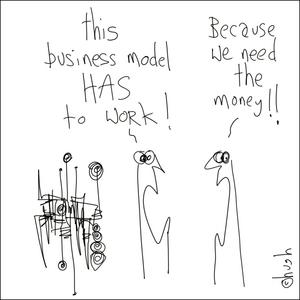
Cartoon Credit: http://www.gapingvoid.com/thisbusinessmodel876-thumb.jpg

Using the Power of Mobile for Good Causes

The New York Times has an article on “cellphone fundraising”, which unfortunately focuses on the wrong points: They mainly report about PR-needy consumer-protection associations that quarrel about the fact that users who want to donate $20 to the Red Cross are being charged 4x 15c SMS charges as the agreed maximum donation is $5 (and they would probably be quarreling if there wasn’t a maximum for it would drive people into certain poverty).

Folks, you need to get out more! Isn’t it great that you can donate money to the Red Cross like this? The administrative costs for a mobile campaign will arguably be lower (and hence the return for the charity higher) than with the use of traditional means. The Red Cross gets more money. Everyone wins!

The concept of cause-related mobile campaigns – and that doesn’t only include actual fundraising – is fantastic:

  1. As has been mentioned a gazillion times, mobile phones have the capacity to being the most targeted marketing approach known today. Conversion rates should be very high and acquisition cost per capita therefore very low. E.g. did Rights Group’s collaboration with U2 and the ONE campaign exceed 25% response!
  2. People tend to part easier with their money for causes they believe in. In particular calls for smaller amounts as they are already customarily being paid for via mobiles would appear to be attractive.
  3. Premium SMS is one of the most efficient micro-billing tools in the world. It is globally available and simple to use.
  4. The overall cost of premium SMS would need to be lower than those for traditional fundraising.

More power to mobile charity work!

Page 6 of 6

Powered by WordPress & Theme by Anders Norén