Category: OEM Page 10 of 15

MEF's Crystal Ball

Industry body MEF had put out its top 10 predictions for the year a few weeks ago (inexplicably missed by me; well it was somewhere around Mobile World Congress, so probably at least excusable), which they gathered from their members and deep discussions around this. They believe that 2009 – recession and all – will be the year in which mobile entertainment (if you count everything in, apparently a $25bn industry) will start to deliver returns.

So now, without any further ado, here are the predictions:

  • The ‘iPhone effect’ -Mobile applications have emerged as a new content category and the mobile internet will finally come of age
  • Greater value and transparency for consumers will help sustain demand in 2009
  • Some delay in the proliferation of mobile advertising
  • Telcos begin to acts as enablers for the Entertainment industry with services such as billing, authentication and zero tariff data
  • The emerging dominance of services that operate at a multi-platform level
  • The rise of ring back tones
  • Social networking becomes an important driver of mobile entertainment consumption
  • 2009 will be the year that mobile video really takes off
  • Emerging economies will become an increasingly important driver for mobile entertainment worldwide
  • A proliferation of touch screen devices drives discoverability and content usage

Now, now. I am glad to see that a lot of this ties in with “what I have been saying all along”… 😉 But let’s have a closer look at a few of the points:
The iPhone effect. Yes, I have elaborated on this plenty a time, so I will only refer to previous posts, for instance here, here and here.
“Some” delays in mobile advertising. Also: dealt with on numerous occasions, and a while ago, too (see here and here)…
And now for a whole bunch of stuff that can, I believe, be grouped, namely greater (perceived?) value to consumers and carriers moving into smart-pipe models. The jury is still out on this, isn’t it? Although it has to be said that there seems to be a learning curve indeed. But is this from new-found wisdom or because of the fruity pain from the guys in Cupertino?
Another group: multi-platform services and social networking. I would class the latter as the shining beacon of the former: social networks do one thing. They connect the dots, they are the switchboards of the digital life. And since users per se do not really care on which screen this happens, a lot of them have seen significant value contributions from mobile (e.g. MySpace sees incredible growth rates).
So there you have it…

"Recession? Where?" Asks the Smartphone…

I previously looked at recession-busting sectors and products, and here’s more proof that not all is bad: two reports point out that smartphones continue to outperform the market rather significantly, recording growth figures of 25.9% year-on-year in Europe; the growth for all of 2007 vs 2008 was even more impressive: they grew by 36.1%. In the US, smartphones increased their share of the overall mobile phone market from 12% in Q4/2007 to 25% a year later. Good numbers!

Half of the (US) smartphones now come with touchscreens, with 70% “instead” (?) having a QWERTY keyboard (my best guess is that this includes phones with a slide-out keyboard, such as the T-Mobile G1 or the Sony Ericsson Xperia).

So how come? The iPhone but also other devices like Blackberries, Nokia’s higher-end phones (e.g. the N95) have powerfully demonstrated that the use of a mobile for things other than using voice and SMS (and take the occasional snap with a so-so camera) is not the end of all things. The overall feature sets of smartphones but – possibly more importantly still – the overall user experience is generally significantly better on a fairly comprehensive scale, and this – in particular in times of recession – would suggest a much higher value for money (“if I pay £50, then I get 4x in value of what I would otherwise have.”): they now all contain decent cameras, enough storage to work as a decent MP3 player (or in Apple’s case even as an iPod…), they do e-mail, connect more effortlessly to the Internet, play more fulfilling games and generally provide a much richer content experience (did I just hear “widgets”?).
For the content industry, this is good news: more powerful devices are generally easier to address and provide a better route to transport brands and production values across to the small screen. The iPhone has shown (see e.g. here and here) that users DO use their phones for all sorts of things if one makes it easy for them. Therefore, the smarter the phone, the higher the consumption. Good, good!

Top 10 Phones in the US, December 2008: the Ascent of the Smartphone

There’s new data out on the bestselling handsets, and this time it is not being derived from accessory sales (which may have its flaws as I pointed out here) but from a survey amongst service reps and store managers across the 4 big US mobile networks (Verizon Wireless, AT&T, Sprint Nextel and T-Mobile; these comprise 85% of the total subscriber base). Now, this would arguably reduce the recorded sales for the iPhone since this is also being sold via Apple’s own retail stores as well as Walmart, Best Buy, etc. So again not an entirely accurate yardstick, huh?

It is noteworthy that only one handset is available on more than one carrier (and, yes, it ranks prominently amongst the top 1) and that Nokia, despite all waiting, has still not managed to break the top 10.
It is also noteworthy that most of the handsets would certainly be classified at smartphones (the Samsung Rant might be the exception). And this is certainly good news. The T-610 and RAZR may finally have left the building…
So here we go (number in brackets is the previous month’s rank):
1. (1) Blackberry Curve
2. (2) iPhone
3. (3) Blackberry Storm
4. (6) LG Voyager
5. (4) LG Dare
6. (5) Blackberry Bold
7. (-) Samsung Rant
8. (9) Samsung Behold
9. (10) Samsung Instinct
10. (8) LG Env2
Source: Rankings are by Avian Research LL.C. (via the above link)

Top 10 Smartphone Games & Apps 2008

Smartphone content vendor Handango releases a smartphone “yardstick” every year containing the top sellers from data in their store. Anecdotally, smartphone apps are more often sold via direct stores (rather than operator decks) than “normal” (not smart?) phones, owing of course to the better connectability (not necessarily connectivity) of high-end phones: input mechanisms (Querty, touchscreen, better D-pads), almost always 3G phones, etc make for a more satisfying user experience (try inputting a web URL via a basic phone keypad… painful!).


They had just under 10,000 apps on offer (spread across Blackberry, Windows Mobile [pro and standard], Palm, Symbian and Android). The average price point was a rather healthy $19, and users downloaded 1.12 apps on average.

Handango also says that games rose as part of overall “top category” sales (whatever that is) from 11% in 2007 to 19% in 2008. This is encouraging. Even so, there is no game amongst their overall best-sellers for 2008. Here’s the list (price points at the end of each line):
1. Spb Mobile Shell 2.1.4 (today screen plug-in) – $29.95
2. MobiTV (streaming television) – $9.99/month
3. Ringtone Megaplex (ringtones) – $19.95
4. Spb Backup 2.0.1 (file backup) – $24.95
5. Spb Pocket Plus 4.0.2 (today screen plug-in) – $29.95
6. Pocket Informant 8 (today screen plug-in) – $29.95
7. Spb Phone Suite 1.3 (phone features) – $19.95
8. VoiceControl (voice command) – $6.00
9. Colour Your Trackball (trackball customizer) – $4.95
10. eWallet (Professional Edition) (PIM manager) – $29.95

The top 10 games across platforms for smartphones is this:

1. Spb Brain Evolution 1.2 (puzzle game)
2. Aces Texas Hold’em® – No Limit (card game)
3. TETRIS (puzzle game)
4. Guitar Hero 3 Mobile (music game)
5. Bejeweled (puzzle game)
6. Aces Solitaire Pack (card game)
7. The Sims 2 (strategy game)
8. Jewelrumble 2 (puzzle game)9. Sudoku Puzzle Pack (puzzle game)
10. Solitaire Buddy Gold (card game)

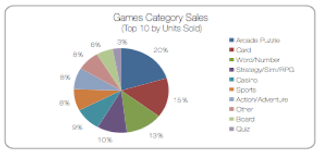
And here’s a chart of the game categories – and, no, still no first-person-shooters in the top 10:

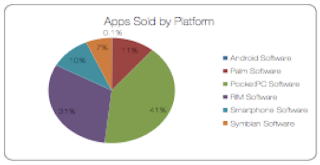
A noteworthy bit in the “Yardstick” is that Android already makes up for 10% of their sales (or so would the below graphic tell us). 

From this, it also occurs that Handango does not consider the iPhone to being very smart. Hm… Well, it’s probably that everyone who buys content on that one will buy not buy it from Handango but through the AppStore. OK then…

iPhone Mobile Entry Gate for Game Developers

Having just spent three incredibly inspiring days at Casual Connect Europe in beautiful Hamburg, there were – in respect of mobile games – two observations to be made: 1) the horror online and PC game developers express when looking at the fragmented space and the resulting “crazy” (quote) business models and 2) the iPhone is different, from a developer perspective this time.

Many, many developers of PC and Mac-based games (be it downloadable, online, browser-based) look at the iPhone as an entry gate to mobile gaming. A lot of the developers I spoke with were interested to work with a specialist mobile games company with a view to bringing their content across to the mobile platform but would not consider including the iPhone in this: “We’ll do iPhone ourselves. It’s a pretty easy platform to work towards and we understand the distribution model.”
This is likely to mean that there will be an ever-growing influx of games from reputable and experienced game companies onto the iPhone, and this might just increase the gap between Apple’s hit phone and the “rest” in content terms even more. Today, there are c. 4,500 games available for the iPhone (or so I hear; and remember that this is a mere 7 months or so after the AppStore launched), and a lot of providers are still missing on there. Whereas “traditional” mobile games have very high barriers to entry because of the complex (and hence expensive) landscape that one needs to address (hundreds of handsets, hundreds of distribution deals all to be struck with very big, often slow-moving “old-school” companies), none of this exists for the iPhone: Apple provides a simple agreement, there is one build to be delivered and one store where it is sold. Easy!
Irrespective of where the remainder of the mobile world will run (and they all seem to run now in order to catch up with the latest “Apple Revolution“), the AppStore is likely to become the first test case where game developers from different backgrounds (PC, online, etc vs. “traditional” mobile) will compete for customers directly. The former have a huge advantage in that they could leverage their online presence to promote the mobile version, too. This is only done by a few of the mobile “pure-plays” and it is tough to compete for eyeballs with an online games company that has 100m+ unique users per month. On the other hand, the mobile specialists have better knowledge about the specific mobile device constraints (which are very different to the ones on a PC).
Another interesting field to watch this year!

RIM's 50m & Symbian's riposte

Blackberry maker RIM announced it had raced through the “epic” 50m device barrier. An honourable feat indeed! Symbian fired of a riposte (or was it Symbian-fan-boy-bloggers that did? I don’t know) that it had sold just under 80m devices in 2007 alone (with a total install base of 250m), and the Blackberry story therefore was to be considered as “how very quaint”.

Now: isn’t this comparing apples and pairs? Every Blackberry is (and has been for, like, ever) the benchmark device for e-mail on the go. I still remember sitting in Moscow pulling down my e-mail on a Nokia 9300, and, in the time it took me to download the header of the e-mails when my dear US colleague had browsed through his e-mail and replied to 5. So: Symbian is not to be equated with Blackberry; it’s an entirely different thing: Symbian was all about creating a more powerful OS that could do a lot of things, and it does them fairly well. But we shouldn’t forget that most of them a N-Series devices without a QWERTY keyboard that do different things than a Blackberry does. It is probably possible (now, not 3 years ago) to create a similar experience on a Symbian-powered phone than it is on a Blackberry but I have still to find an e-mail client on a phone as pain-free, reliable and quick as the Blackberry’s.
I do believe that it is less about the theoretical power of an operating system but about the end-to-end experience (iPhone anyone? I commented on this a long time ago). And – across the board – a Blackberry beats most of its rivals hands down on that; still. So this comparison limps heavily. It is probably also to blame on this odd way to define “what is a smartphone“? The mere fact that it has a “an identifiable operating system” surely is not that smart (although Admob classifies it as such). 
I applaud RIM to their feat of selling 50m devices (or “i-banker phone” as they were called in their early years) and remain a fan.
On a sideline, RIM also mentioned that there have been 7m downloads of the Facebook client for the Blackberry so far. This would mean that a fairly respectable 15% of all Blackberries that have EVER been sold have the client, and this means that this is probably a rather high number of the ones currently in use. Who would have thought that? I-banker phone goes social networking. Ts ts ts…

Top 10 Mobile Phones in January

Our beloved manufacturer of carrying cases for portable electronics, Krusell, enlightens us again with their top 10 list of best-selling phones for the month of January 2009 (or should that be best-selling phone holsters?). 

1. (1) Samsung SGH-i900/i910 Omnia
2. (-) HTC Touch HD
3. (9) Nokia E51
4. (-) Blackberry Storm
5. (2) Nokia 6300
6. (5) Nokia 3109
7. (7) Sony Ericsson X1 Experia
8. (8) Nokia E71
9. (-) Nokia 6220
10. (10) HTC Diamond
The number in brackets is the rank from the prior month.

Now, as compared to all of 2008, the iPhone went from #1 to nowhere. I explained this before: they track phone sales by the number of model-specific accessories sold, and I am still not sure if that makes any sense. I see this more in practical terms: the “suits” carrying around their business phones do not seem to have the fashion sense to realize that specific phone cases is nothing that one does (this is also popular with taxi drivers), and therefore it seems obvious that a lot of “business-type” phones are in the list (and none of the “classic” Blackberries because they have their uber-cool faux-leather holster in the box (and, yes, that’s the piece I throw away first!). 
Let me know what you think!
Photo credit: http://blogfreespringfield.com/wp-content/uploads/image/holster.jpg

Page 10 of 15

Powered by WordPress & Theme by Anders Norén