
Tag: Nokia Page 7 of 15

AdMob on iPhone ad impressions and why Andrew Bud is wrong

Mobile advertising firm AdMob has released some numbers on ad impressions on iPhone vs other smart phones and the result is, well, that Apple is basically a 50kg flyweight boxer competing against Sumo wrestlers 5 times it weight (8% smartphone footprint but more than 40% ad impression share).

Now, very (!) crudely put, this does not mean that it is 8 times as successful on mobile advertising. It does mean however that users are 8 times more likely to use applications where ads are being displayed. Here’s some of their stats:

iPhone Apps (in AdMob’s network):

  • The top iPhone apps had more than one million users in the UK in May 2009
  • 5% of iPhone apps had more than 100,000 active users in May 2009
  • 14% of iPhone apps had between 10,000 – 100,000 active users in May 2009
  • 27% of iPhone apps had between 1,000 – 10,000 active users in May 2009

Mobile web browsing market in May 2009:

UK:

  • 48.7% of ad requests came from Apple handsets (iPhone and iPod Touch)
  • 28.4% of ad requests came from the iPhone
  • 282,493,761 ad requests from users in the UK

US:

  • 45.1% of ad requests came from Apple handsets
  • 25.7% of ad requests came from the iPhone
  • 3,804,373,544 ad requests from users in the US

Global:

  • 31.4% of ad requests came from Apple handsets
  • 18.6% of ad requests came from the iPhone
  • 7,997,946,483 ad requests from users around the world

Interestingly, MEF and MBlox Chairman Andrew Bud (who is being quoted at the end of the article) said that Apple’s app store compared to Nokia’s Ovi Store like a niche boutique to Tesco (or, if you are in the US, Walmart). Is that so? No it is not. And here’s why:

Apple is a boutique with more items on sale than a Tesco megastore. And its (less) customers buy trolleys full of wares. Moreover, their high-spending customers leave the store with a spring in their step and committed to come back the next day.

Nokia is a super-store with gazillion potential (!) customers where 1 in 20 stroll through aisles stocked with not so cool things and most of them walk out without buying anything and, on top of that, feeling fairly downtrodden and frustrated about what was on offer.

So, for the time being, I’d choose the Apple boutique. If that choice changes will depend on whether Nokia will manage to stock their shelves with more compelling wares and improve on their tills (less queuing, more bang for your buck, etc). Oh, and get those cold strip-lights replaced, please!
Top 10 Mobile Phones in June 2009

Here’s our monthly update on the best-selling phones as derived from accessory sales by Swedish company Krusell. They seem to be having a new product line: the iPhone shows up now (and as a “new entry” no less). It is arguably to show the limited value of this table in terms of overall sales.
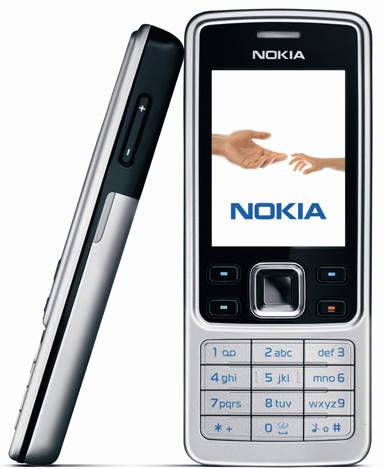
It is noteworthy that June’s #1 phone (Nokia 6300) is a handset that was introduced to the market more than 2 years ago. Now it is a very solid performer (as my wife will tell you) and has been used as a very good-value phone (£0.00 when bought on a pay-as-you-go) by a lot of carrier. Or is it that the phone is now so shabby it needs to be covered by a plush holster? :p

I thought it is also noteworthy that Nokia’s new flagship the N97 (or any other N-series Nokia) is not featuring at all… It might be early days for the N97 but the others?

Well, make of it what you will, here’s the top 10 list (oh, wait, it’s a top 11 this month; woah):

1. (3) Nokia 6300
2. (-) Apple iphone 3G
3. (-) HTC Touch Diamond 2
4. (2) Nokia 3109
5. (-) Nokia E51
6. (1) Nokia 5800
7. (5) Nokia E71
8. (6) HTC Touch HD
9. (-) HTC Magic
10. (-)HTC Touch Pro2
11. (4) Samsung SGH-i900/i910 Omnia
() = Last month’s position.

LG is Bullish: 9% growth in 2009

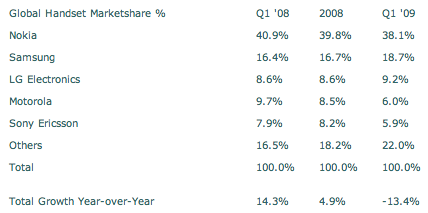
Not all is in recession it seems. The handset vendor world #3, LG predicts to ship 110m phones this year, which would represent a 9% increase in volumes on a year-on-year basis (see the market shares for 2008 and Q1/2009 below; courtesy of Strategy Analytics) in the face of what it believes will be an overall flat market this year.

So whilst everyone is shrinking, LG is growing. Everyone? Ah, now, Samsung is growing, too. The victims? Seemingly Motorola and Sony Ericsson with Nokia also suffering. No news then? Well, by 2012 LG wants to be #2 and ship around 200m devices (which would be 100% more than in 2008). So 9% growth wouldn’t get them there, would it?

Joking aside. Is this surprising? I think not. LG had had a couple of very “pretty” devices out. Starting with the LG Prada, they came out with the “Shine” and had a great success with the Viewty. They have been upping their game at a time where in particular Sony Ericsson and Motorola had been struggling to compose a coherent product strategy, and this will have enhanced the overall effect.

Carnival of the Mobilists # 178

venice_carnival_2009Welcome to the Carnival of the Mobilists, which has finally arrived on this blog, and how timely, too!

Last week marked not only the launch of the long-awaited Palm Pre but also featured Apple’s Worldwide Developer Conference (without Steve Jobs threatening to quit this time), so the theme would appear to being set: it is all about smarter phones, is it not?

And, lo and behold, this is exactly what this week’s worthy posts focused on, and from a variety of angles. It apparently energized some of the best and brightest to set pen to paper (or thumb to keyboard; can somewhat come up with an updated simile, please?). So off we go:

We are first and foremost being treated (!) to another of Tomi Ahonen’s epic posts, this time a journey through the times of the smartphone, from Nokia’s first Communicator (oh, how I loved my “brick”) to the iPhone, N97. Specifically, he looks at how differently the concept developed in the US vs the rest of the world. He also tells us where he thinks the real future lies (hint: not in apps apparently…). It is an absolute must-read even if a) you’ll need a good cup of coffee and a bit of time to read it and b) Tomi’s Finnish heritage does shine through on more than one occasion… 😉

Ajit Jaokar’s Open Gardens Blog follows on this theme: he argues that the Web just moved and that this will impact the balance of power with the web winning (hint: this is coming closer to where Tomi thinks we’re going, too).

Peggy Anne Salz’s MSearchGroove blog lends its space to Ben Jacobsen, the former Director of Global Marketing for Opera, who has some numbers to put against predictions that apps won’t really matter by looking at the real value of the app industry (it’s apparently $3.2bn in 2009 growing to $7bn in 2013) and the opportunities for app stores (hint: it is not Apple that rules). He also – rightly – points out however that the fact that Opera’s Mini browser is the top downloaded Java application of all time provides a good outlook on where the real opportunity lies.

Judy Breck suggests that smartphones have become a defining tool to ensure social equality in education: she urges to give smartphones to Washington DC school kids to make sure access to information is the same irrespective of class and income.

If you want more proof on how the web enhances your mobile experience, here you go: Aaron Chua shows us some intriguing examples of mobile applications that combine mobile device functionality with the information available online. Geoff Ballinger throws in his comparison of the price plans competing in the UK with the new iPhone 3GS’s tethering option (just in case you were wondering if it made sense).

And then, here is a voice reminding us that there is not only the web to connect to but the real world, too: Andrew Grill gives us a heads-up on Unilever’s thoughts on mobile coupons. They realized that they might be able to reach youngsters who might not be so keen on cutting out paper coupons anymore…

Before I go, here are two very noteworthy posts on events you should try not to miss:

Caroline Lewko’s WIP Jam Sessions stage events on various mobile open source topics in Amsterdam, Berlin and Marseille.

And then of course Rudy de Waele opens Mobile 2.0 on 18/19 June 2009 in beautiful Barcelona.

And Rudy has a special goodie for Carnival readers: he is giving away 2 FREE TICKETS to both the developer day (otherwise sold out!) AND the conference. Here’s how to win the ticket: send your definition of what is Mobile 2.0 in a tweet tagged #cotm to @mobile20 before this coming Tuesday 14h (CET). Rudy will choose the best and announce the winners on the day.

Post of the week goes to Tomi Ahonen’s tour de force of the smartphone world (but he also receives a caution for being maybe a little too rose-tinted over Nokia – I am referring to their recent innovative forces rather than their early revolutions…).

Now go, click those links and dive into what will hopefully bring you (even more) insight and inspiration. Have a great week!

Image credit: http://tinyurl.com/mg2lto

T-Mobile, Nokia & Skype

Nokia’s deal with Skype did not go down too favourably with German carriers T-Mobile and Vodafone, and there had been threats that they would drop the respective Nokia devices (including the long-awaited hero handset N97) from their device roadmaps. Today, T-Mobile provided some “clarification” on the issue: according to a spokesperson, T-Mobile apparently wants to ship the N97 but not with the Skype VoIP client installed (“it is up to us to decide what is on the device”).

It was also said that the carrier was looking into options on how to deal with VoIP but that it was still early days. However, T-Mobile does apparently not block VoIP clients, neither Skype nor others… Hm, this does not sound like a convincing policy to me…

To Skype or not to Skype: Nokia vs Carriers

The most excellent German blog Mobile Zeitgeist alerted me (in German) to a little battle that illustrates the pitfalls of creating the seamless user experience: Nokia appears to being in a tussle with (at least) the German arms of Vodafone and T-Mobile over the pre-installation of Skype clients on some of its forthcoming handset models (including the long-awaited iPhone competitor, N97).

Vodafone and T-Mobile Germany (who have a combined subscriber base of close to 80m) have now publicly stated that they will not include any Nokia models into their catalogues, which will have Skype installed. Now, there’s a market gone dead then… For other models, look to 3 in the UK (and my post on the Skypephone there…).
T-Mobile said that they “would not let their business be destroyed” by this. Their terms and conditions prohibited VoIP clients already but the carriers did anecdotally turn a blind eye towards this in the past. Nokia’s push however now is apparently too much for the carriers who fear network issues. Interestingly, this surfaces on the same day where, in anther part of the world, some queried the sustainability of free data plans for the iPhone (namely the Wall Street Journal on AT&T’s policies in respect of the iPhone). Predictably, Skype lambasted the move as “unfair practice”.

The name of the game is – of course – the pipe (not new: see e.g. here and here): the WSJ quotes from an Alcatel-Lucent analysis of North American networks during the midday hour of one day, which apparently shows that web browsing consumed 32% of data-related airtime but 69% of bandwidth whereas e-mail used 30% of data airtime but only 4% of bandwidth. The reasoning goes that increased data traffic impacts the networks’ capex whilst remaining – at best – ARPU-neutral (AT&T ponders to drop its data plan for the iPhone by $10), cutting down margins and hurting the carrier more than is healthy. Voice and SMS services are – on a bit for bit basis – very, very profitable as they use very little bandwidth.
To conclude though – as the WSJ does – that unlimited data plans should be abandoned “in the short term”, pours the baby out with the bathwater: smartphones are paving the way into the wireless future (20% of US households are completely wirefree already!) and it is a space where the carriers have great gains to make; maybe not on the sumptuous margins they were used to but healthy and viable nonetheless. To do as the WSJ asks would be as if one would have asked ISPs to please stop flat-rate plans for Internet access; and look what has become of the Internet!
Accordingly, other voices argue that a) slowing voice ARPU is at least being part set-off by increasing data ARPU (which grew a healthy 32% year-on-year in Q1 and saw more than $10bn in wireless data plans being sold in the US for the first time), and b) that the carriers actually know this for a while now and, accordingly, upgrade their networks to better cope with higher bandwidth demands in order to make the move to data pipes; the fight is arguably now “only” about whether these would be dumb or smart: with app stores, VAS and business-to-business (and machine-to-machine) solutions opening up vast new segments that have been completely unexploited to date, one should think that there is room for the smart pipe operator. So fear not!

Nokia Ovi's 20,000+

Nokia’s interpretation of an app store will be Ovi, and it will launch later this month. This is a biggie since Nokia (according to its own numbers) still commands an imposing market share of – globally – 37%. True to its huge self, it now said it’ll come out with all its guns blazing and kick its app store off with no less than 20,000 “items”! This is being compared to Apple’s “few hundred” upon launch.

However, that contains of course quite a bit of a PR spin: Nokia does not only include applications in its count but also videos and “mobisodes”, and on this definition, one would need to count in the 40,000 or so videos, 3,000 TV shows, etc that the iPhone had on offer via iTunes (numbers via Wikipedia).

So where does Nokia truly stand in May 2009? The company, once famed for cool design (7110 – also known as the “Matrix” phone anyone?) and intuitive UI (yes, really: in the pre-Java age, Nokia’s were second to none when it came to usability and interface) seems to have lost a little of its gloss. Its devices still boast technical excellence (the N96 technically outsmarts every iPhone or Android device easily) but the sex-appeal is considerably lower. Nokia anno 2009 has a little more of a Siemens-like flavour: very well engineered but a bit dull and maybe, well, a little over-engineered. At a time when content finally seems to go mainstream, this is more than only unfortunate: Nokia’s often announced push into the US (where it holds an uncharacteristically small market share) has faltered (again) but the company also seems to lose market share in regions where it previously was unassailable. Moreover, its incremental products, such as the Navteq business, appear to struggle, too (Navteq recorded net sales of only €132m in Q1/2009; compare that to a purchase price of $8.1bn!), as it is arguably being challenged by the – free – Google Maps (which most people I know prefer over the – paid-for – Navteq services).

Nokia’s competition comes less from its traditional foes, Sony Ericsson (struggling itself), Samsung, LG or Motorola but from the newbies like Apple, RIM or HTC, all of which focus on the upper end of the market and leverage this with smart phones that comes – app store or not – with a vastly expanded range of apps and services. Apple has leveraged this in breathtaking ways but one must not forget the gains Blackberry-maker RIM has realized. And while this was not on the back of its app store (Blackberry App World launched only recently), Blackberry devices had always been used for more than only voice and SMS – data services were always at the core of the product.
So where will Ovi sit? Will it revolutionize the mobile phone mass market on the content side, too? Nokia’s attempts so far were something of a mixed bag: Preminet must probably considered a failure, its successor NCD (Nokia Content Discoverer) was always a little bit in the shadows, too. N-Gage is a distinctly high-end service (with – anecdotally – 1m or so subscribers, which is small when you look at Nokia’s overall market footprint), the P2P service Mosh was known (to the people who actually did know of it) for the piracy taking place on the platform rather than for commercial success. In short: Nokia’s moves into content have not been an overwhelming success so far. Ovi has the opportunity to change this. Due to its massive market footprint, Nokia has the opportunity to turn more than 1bn devices into shop windows for content, and this outmuscles anything Apple could even dream of achieving by large margins.
However, the success of an app store is not being defined by the sheer number of content available on or through it but but at least equally by the functionality, the usability and discovery. This is where Apple has been doing so well: the combination and seamless integration of hardware and software and its content strategy out of one mould (with no carrier intervention at all) has lifted the bar for an interface significantly. It might look easy to copy this but it is not. Nokia has also been very (!) late to the game (bear in mind they first announced Ovi in 2007!), and it acknowledges this itself. It will therefore be very interesting to see how Nokia manages to execute it. Be not mistaken: if it succeeds, the content revolution on mobile has truly begun!

Page 7 of 15

Powered by WordPress & Theme by Anders Norén