Here is the presentation I delivered at Casual Connect Europe in Hamburg.
Mobile + Social: Show us the Money
View more presentations from Volker Hirsch.

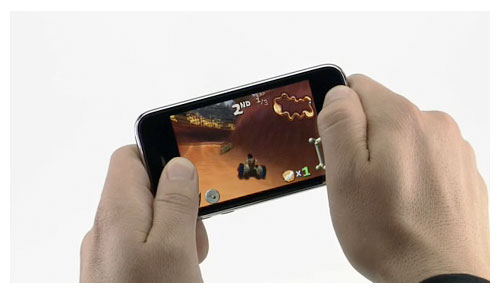 We said it before: mobile is the biggest mass medium on the planet, and now game developers (and not only the sometime masochists that have been there for years) flog to it. According to a fairly large survey by GDR (which can be yours for too many dollars to count and has been reported about here) among 800 developers, a quarter of them are now making games for mobile phones with most of them (namely 75%) – surprise, surprise – choosing the iPhone as their platform of launch. This is doubling last year’s figures (apparently).
The iPhone and its non-phone sibling, iPod Touch (and you have been reading that a year ago here, here and here) are proving a more attractive launchpad onto portable gaming platforms than dedicated gaming systems like the Nintendo DS and Sony PSP.
The reasons will be the same as they were a year ago: a platform that is relatively easy to work to and a simple distribution model. With the number of downloads Apple continues to pile up, it is no wonder that developers from “traditional” platforms (PC downloadable, online, etc) are attracted to that. They will also be less scared of the marketing challenges since they had had to market their games in the whole wide oceans of the Internet previously (i.e. there were no carrier safe havens with feature slots). Whilst this does not mean that every traditional developer’s games will be successful on the app store, the threshold to enter is lower.
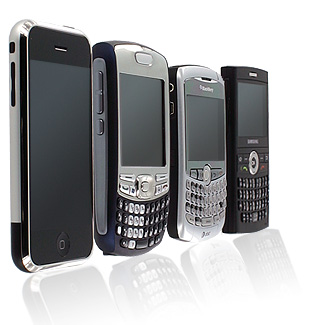 It will be interesting to see if the wave will roll further into other “smarter” platforms, including Android, Windows Mobile (see the latest rumours for WinME 7, including full Xbox Live gaming implementation here), Symbian Maemo and Blackberry. With the device numbers clearly speaking in favour of that, platforms becoming more accessible and, last but not least, with easier paths to the users via OEM app stores, this is to be expected. Good times for mobile gamers!
 Quick facts: I am an iPhone user. I wanted one, I am based in the UK. What to do? Switch to O2, which had the exclusivity for this. This post is not about bandwidth, 3G availability or anything like that – I have not (much) to complain about this actually. It is not about the iPhone either.
This post is about the simple mistakes network operators (plural; O2 is not alone here) make by not living up to their own messages. Listening to customers and identifying (and answering!) user needs.
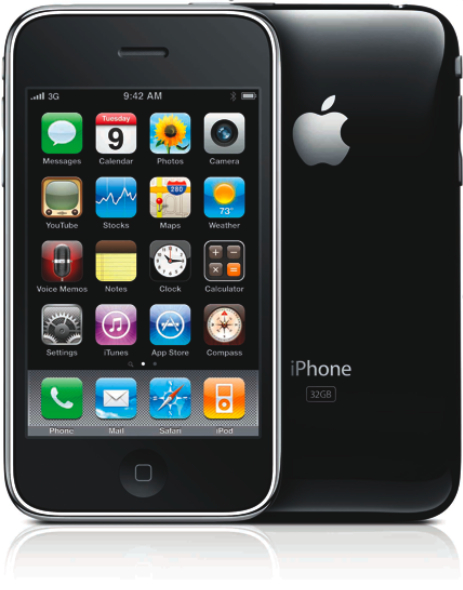 Back story: I have an iPhone 3G on a £45/month plan, which gives you countless voice minutes and lots of SMS and unlimited data – in the UK that is. In short, I do not normally have to pay anything for (UK) calls and texts, hence the tariff. Now, if you dare travel with your iPhone, you’re in for nasty surprises. The only thing O2 UK has to offer is slices of 10 or 50MB of data for some hefty sum.
One of the most insulting things about this is this: I used to have a Blackberry on O2 and, you see, you can purchase an international roaming plan that gives you blanket data coverage on your device when abroad for – if I remember correctly – £25/month extra. Would I take this? Any day. Does this exist for iPhone tariffs? No.
O2 UK would be able to easily deduce that I am traveling regularly. Great opportunity to hook me into an even dearer deal, you might think (ad slogans include “We’re better, Connected” and “O2 can do”). But wrong you are. Whenever I travel with O2 abroad (and this is on an O2 network), this is what I get:
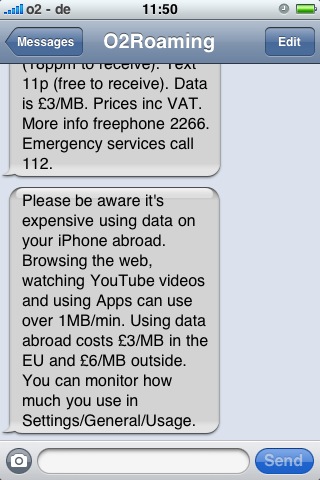
They actually send me at least 3-4 SMS with various warnings and alerts about how expensive and truly nasty it is to use my (O2-purchased) phone to its full potential and capacity whenever I dare leaving British soil. Connected? Can do? Not at all! Very inspiring. NOT!
Does it offer ANY solution to my apparent need? No. Does it try? No. What does this say about how important I am to them as a customer? A lot. And nothing good either.
It reveals a very “last century” way of looking at life: users are basically being perceived as revenue-generating units rather than someone the brand even attempts to communicate with. This is a very short-term view of the world, and one that is bound to fail quickly. Why? Because I am very likely to switch carriers (I have already unlocked my iPhone, which you can – incidentally – do here).
Now, O2, listen up: will I switch because there are so many other so much better offers out there? No. Will I do it because I fear the charges? No. I might end up paying the same as before. But that’s OK. I will do it because you, my dear carrier, showed me that you do not give a toss about me as your customer and you failed to deliver on your promise (“connected”, “can do”). I beg this will change about 2 weeks before my contract with you runs out: you will promise me everything under the sun to keep me but this is cheap, and I will not have it (as, I suspect, will apply to countless others).
Here’s the solution: Try and build some trust in your brand and your actions (Zappos anyone?). The reference to Zappos is not only a fashionable one (and, yes, I know it turns up in every man and his dog’s presentation these days; I used it myself a couple of weeks ago… But Zappos business is, get this, O2, to deliver happiness. You think that this is over the top? Think again: Tony Hsieh just sold his company for a very real-worldly price of $800 million to Amazon. His company is America’s biggest shoe retailer. Did I say shoes? Happiness!
Do you have to go that far? I would wish you would. But, dear O2, a little respect and care would already do it. Any of this? None I can see or hear, and your hotline will know I have tried! In modern “Tweetish”: #fail.
Listen and deliver. Then the rest will come. Until then, it’ll be Vodafone for me (who at least abolished roaming charges) or Orange (if they manage to learn from the above in time before my contract runs out).
Good bye!
Here’s this week’s Carnival of the Mobilists (its 201st iteration in fact). This week, the Carnival is hosted over at Phil Barrett’s Burning the Bacon blog, and he has lots of goodies to share, including my own post showing an example of why Nokia struggles. Besides this, you will find posts on:
Go now and give it a good read. You’ll find the carnival here.
 First, Samsung announced it would drop Symbian from its smartphones in 2010 in favour of its new, home-brew bada OS. Then Nokia said it would drop Symbian (albeit not immediately) from its flagship N-series devices replacing it with Maemo, the OS that premiered on a Nokia device on the recently released geek dream, the N900.
It is said that there are
no current plans for Maemo devices in the […] X-Series range or the popular [?] E-Series enterprise range
but the word “current” suggests that this might well change soon, too.
This would leave Symbian without its two largest OEM supporters. Will there still be a future for it?
 Symbian of course boasts a still very impressive number of legacy devices, and it will therefore be here for a while. However, what does the long-term outlook look like? Android, LiMo, etc all “boast” a nimbler, more agile set-up, allowing for faster development and, arguably, better user experience. This is not necessarily Symbian’s fault (it carries with it its legacy around) but it makes it that much harder for it to reinvent itself.
I am not sure if there is place (and – timewise – the runway) to reinvent itself without the backing of big OEMs. I would be surprised if carriers would use it; they – even more than OEM – require adaptability and customization, which the newer platforms seem better suited to serve. Vodafone’s choice of LiMo for their first two Vodafone 360 devices is testament to that.
The ever-bright Tomi Ahonen suggested a comparison with DOS/Windows and MacOS: he compares Symbian to DOS, Maemo to Windows and iPhone to MacOS: MacOS led in UI and leads to this day. DOS outsold MacOS in spite of its dramatic inferiority because of the legacy instal base. Windows then overlaid DOS and rolled out on all the legacy devices with MacOS, as a result, always playing second fiddle despite its superiority.
The market place in mobile looks different though: DOS was nigh dominant (outside the mainframe and large enterprise side of things) whereas Symbian “only” covers about 5% of the current market. It is big but probably not big enough to bridge the DOS/Windows migration gap. With Android, Blackberry, Windows Mobile, LiMo, JavaFX (if that ever takes of properly), etc all on the map, too, the situation is very different to the DOS/Windows/MacOS world. Would Nokia be quicker in execution, I might still look at it differently but, unfortunately, it doesn’t seem to be that way.
So is it good bye, Symbian, then?
Ahead of CTIA later this week, this edition of the Carnival of the Mobilists is being hosted by Tsahi Levent-Levi on his VoIP Survivor blog. This week brings an incredible line-up of topics and contributors: A couple of posts on mobile advertising (including mine pleading for engagement as a crucial factor of ad success), the ideal app store, mobile learning and a whole host on the use of mobile apps in the workplace (including one with a Blackberry in a bakery!) and corporate environment in general plus a look on service and feature requirements for mobile phones in the developing world.
All very good indeed! So head over and set aside a good hour to read! You’ll find it here.
 In the last two days, two forecasts informed us about the value of the mobile app market in – convenient as ever – the distant future that is 2013. US analyst firm Yankee Group predicts the US app mobile market to be worth $4.2bn by then. Today, British analyst Wireless Expertise (run by former Netsize exec Anuj Kanna) topped this easily by predicting the (global) app market size to be $16.6bn by that time (free copy of the report here).
I can hear your moans…
However, let’s have a look at the numbers then, shall we? At the end of 2008, there were 4.1bn mobile phones in the market. Because apps tend to thrive most on smartphones (and the analysts seem to thrive on them, too), let’s have a look at that sub-sector. I would estimate the smartphone share to being somewhat under 10% (Symbian claims c. 250m devices in market, Apple has some 30-odd million, so RIM, Windows Mobile, Android, Palm, etc should probably be OK with the balance of some 100m). In Europe and the US, the share is much larger but in the big volume markets China and India it is bound to be much smaller, at least for the time being. Global smartphone shipments in 2008 were around 140m.
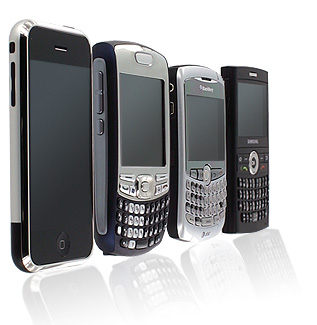 If we estimate a 20% growth year-on-year for smartphones (vs. 5% for the overall phone market, which seems to be loosely in line with the general dynamic), then we would end up with something like 900m smartphones by 2013. Yankee Group predicts that smartphones in the US will quadruple by then (from 40m to 160m) and does not seem to be very far off. Wireless Expertise thinks the global number will be 1.6bn, which again, might not be that far off.
The question is however if people will really download this much stuff: Yankee Group predicts that the actual value of the market will rise 10-fold and that the average price point of an app will be $2.37. Why that is so, you ask? Well, pay $495 and you will know; I don’t…
Now, the good folks of Wireless Expertise see the thing quadrupling until 2013. They do, however, count “ordinary” mobile games as they are being sold through carriers amongst the apps, which means that their starting point is higher, namely $4.6bn in 2009, so they’re looking at this quadrupling. They raise some smart points on app stores and how they (well, it) changed the way users access and consume content, how carriers will need to look for alternatives to increasingly commoditized voice and messaging propositions, etc. But why there should be a 400% rise in e.g. traditional J2ME mobile games remains – whilst it would be wonderful – pretty much in the dark.
Talking of J2ME and feature phones: I do not know how they are being woven into the equation but there would certainly be a wide field for any self-respecting crystal-ball-reader here: on the one hand, app consumption on such devices has traditionally been fairly shabby but, on the other hand, this could well change if connectivity, bandwidth, UI and the right price plans would come together to offer a compelling mobile web solution. So then apps would need to be translated into widgets or something like that. Would users then pay for them? Don’t know. Or would it be the “Freemium” model according to which “Free gets you to a place where you can ask to paid?”
The challenge of these reports is their “simplified” assumptions: if only one of them fails, you go “oops”, and your prediction is halved (or worse). On Wireless Expertise’s case, this is particularly clear: their assumption is that there will be a dual strategy of (presumably OEM-driven app stores) and mobile web-based widget stores. Now, they further assume that Ovi, Windows Market, etc will all be as successful as Apple’s App Store. By early (anecdotal) data, this could not be further from the truth (see here for what that may mean). Nokia in particular struggles to get its head around a viable and compelling media strategy (cf. here and here). And hence the beautiful hockey stick would actually fall flat on its face.
 Now, I am not predicting total doom and gloom, in the contrary. I do think that Apple’s wake-up call has brought a much-needed new wave of innovation and I also believe that this will be successfully incorporated by some carriers and OEMs. But by all of them? Not very likely.
And so we see: the reports are a touch on the optimistic side when it comes to volumes and assumptions. But, hey, that’s their job, I guess, and after all they have at least dropped their masks now: Yankee Group call it fairly openly a “gold rush”. And what happens then we had been shown a long time ago: you end up eating your shoelaces. So maybe this is less of an app bonanza and more of an analyst bonanza then…
Powered by WordPress & Theme by Anders Norén