Author: Volker Page 46 of 73

Samsung Goes Green (or Blue?)

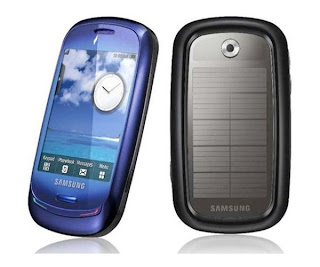
Ahead of the Mobile World Congress, Samsung announced a super-cool device. Cool because it has the word “blue” in its name (it’s name is “Blue Earth”)? Or because it’s all touchscreeny-feely? No! Because it’s very green: 

It’s solar-powered, it is made from recycled plastics (water bottles, just like the Motorola one I blogged about recently). Packaging? Recycled paper. And then it also has a couple of sweet little gadgets: you can for instance see how much CO2 you saved by using the in-built pedometer. Now, this (not the pedometer, the phone) is something rather cool! 

I will maintain – again – though that the question remains why they then do not do this kind of thing across all their products? In particular a company of Samsung’s size and might could surely make a difference if this would not only concern one handset but their entire product portfolio. Come on, guys!

Top 10 Smartphone Games & Apps 2008

Smartphone content vendor Handango releases a smartphone “yardstick” every year containing the top sellers from data in their store. Anecdotally, smartphone apps are more often sold via direct stores (rather than operator decks) than “normal” (not smart?) phones, owing of course to the better connectability (not necessarily connectivity) of high-end phones: input mechanisms (Querty, touchscreen, better D-pads), almost always 3G phones, etc make for a more satisfying user experience (try inputting a web URL via a basic phone keypad… painful!).


They had just under 10,000 apps on offer (spread across Blackberry, Windows Mobile [pro and standard], Palm, Symbian and Android). The average price point was a rather healthy $19, and users downloaded 1.12 apps on average.

Handango also says that games rose as part of overall “top category” sales (whatever that is) from 11% in 2007 to 19% in 2008. This is encouraging. Even so, there is no game amongst their overall best-sellers for 2008. Here’s the list (price points at the end of each line):
1. Spb Mobile Shell 2.1.4 (today screen plug-in) – $29.95
2. MobiTV (streaming television) – $9.99/month
3. Ringtone Megaplex (ringtones) – $19.95
4. Spb Backup 2.0.1 (file backup) – $24.95
5. Spb Pocket Plus 4.0.2 (today screen plug-in) – $29.95
6. Pocket Informant 8 (today screen plug-in) – $29.95
7. Spb Phone Suite 1.3 (phone features) – $19.95
8. VoiceControl (voice command) – $6.00
9. Colour Your Trackball (trackball customizer) – $4.95
10. eWallet (Professional Edition) (PIM manager) – $29.95

The top 10 games across platforms for smartphones is this:

1. Spb Brain Evolution 1.2 (puzzle game)
2. Aces Texas Hold’em® – No Limit (card game)
3. TETRIS (puzzle game)
4. Guitar Hero 3 Mobile (music game)
5. Bejeweled (puzzle game)
6. Aces Solitaire Pack (card game)
7. The Sims 2 (strategy game)
8. Jewelrumble 2 (puzzle game)9. Sudoku Puzzle Pack (puzzle game)
10. Solitaire Buddy Gold (card game)

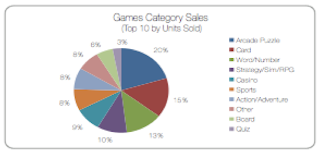
And here’s a chart of the game categories – and, no, still no first-person-shooters in the top 10:

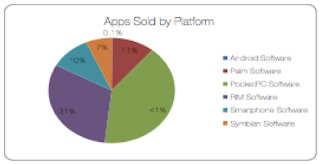
A noteworthy bit in the “Yardstick” is that Android already makes up for 10% of their sales (or so would the below graphic tell us). 

From this, it also occurs that Handango does not consider the iPhone to being very smart. Hm… Well, it’s probably that everyone who buys content on that one will buy not buy it from Handango but through the AppStore. OK then…

Twitter Raises More Cash

I and many others had been speculating if they did or did not need new money (founder Biz Stone says they didn’t) and amidst people scraping together money, fearing long, cold winters of recession, Twitter raised a more than respectable third round of $35m led by tier-1 VCs Benchmark and IVP. This can, according to some sources, still grow as existing investors want to protect their dilution (which would make sense, I suppose). Congrats, folks!

According to Stone’s blog, they do not need the money. However, they felt the offer was so good that they could not say “no”… As they would say…
What is it for then? And, ah yes, they want to use some of the capital to “help build their revenue-generating projects”. And that’s about time, too! On the other hand, let’s not be too derogative: they have been growing at an amazing speed (the numbers I had were 780% last year; Biz Stone now ups them to more than 900%) and with the media making the right noises and even secondary Twitter businesses being funded (which often do have at least the hint of a “how-to-make-money” set-up though), there certainly is something in this. That Twitter has its uses for businesses is a tale that you can read about from hundreds, including the traffic kings Guy Kawasaki and Peter Cashmore (Mashable); the Twittersphere is full of “top-20-business-uses” style how-to guides. 
How will Twitter itself monetize on this? Rumours are flying as always and they range from paid-for corporate accounts to advertising to, presumably, big-media tie-ins. There is so much room to look when you are commanding this big and active a user base that there a plenty of angles; the Twitterati may be younger and poorer than the average (there’s recently been a “Twitter census“)but they are at home in the new social media and they are ultra-mobile with a higher proportion on laptop and mobile usage. Welcome to the future then! I had suggested a few possible avenues previously; and if even I can do it, I am sure they can do it… 😉
Oh, and if you wish, follow me on Twitter here.

iPhone Mobile Entry Gate for Game Developers

Having just spent three incredibly inspiring days at Casual Connect Europe in beautiful Hamburg, there were – in respect of mobile games – two observations to be made: 1) the horror online and PC game developers express when looking at the fragmented space and the resulting “crazy” (quote) business models and 2) the iPhone is different, from a developer perspective this time.

Many, many developers of PC and Mac-based games (be it downloadable, online, browser-based) look at the iPhone as an entry gate to mobile gaming. A lot of the developers I spoke with were interested to work with a specialist mobile games company with a view to bringing their content across to the mobile platform but would not consider including the iPhone in this: “We’ll do iPhone ourselves. It’s a pretty easy platform to work towards and we understand the distribution model.”
This is likely to mean that there will be an ever-growing influx of games from reputable and experienced game companies onto the iPhone, and this might just increase the gap between Apple’s hit phone and the “rest” in content terms even more. Today, there are c. 4,500 games available for the iPhone (or so I hear; and remember that this is a mere 7 months or so after the AppStore launched), and a lot of providers are still missing on there. Whereas “traditional” mobile games have very high barriers to entry because of the complex (and hence expensive) landscape that one needs to address (hundreds of handsets, hundreds of distribution deals all to be struck with very big, often slow-moving “old-school” companies), none of this exists for the iPhone: Apple provides a simple agreement, there is one build to be delivered and one store where it is sold. Easy!
Irrespective of where the remainder of the mobile world will run (and they all seem to run now in order to catch up with the latest “Apple Revolution“), the AppStore is likely to become the first test case where game developers from different backgrounds (PC, online, etc vs. “traditional” mobile) will compete for customers directly. The former have a huge advantage in that they could leverage their online presence to promote the mobile version, too. This is only done by a few of the mobile “pure-plays” and it is tough to compete for eyeballs with an online games company that has 100m+ unique users per month. On the other hand, the mobile specialists have better knowledge about the specific mobile device constraints (which are very different to the ones on a PC).
Another interesting field to watch this year!

JavaFX: and another one…

Whoever had hoped that the iPhone example would trigger an end of the fragmentation will be disappointed. Android will likely come in infinite flavours as and when OEMs and carriers adapt the OS to their specific tastes (I dare not speak of needs…), Symbian when going open-source will likely fare a similar fate, and now Sun fights back to maintain its stronghold by launching JavaFX, which is supposed to provide a bit of zing to the ubiquitous J2ME middleware that dominates the mobile handsets (according to Sun, 2.6bn devices carry it).

It’s early days but I will make sure quizzing our engineers to see what they think.
And now let’s go back to dream of a single platform… Zzzzzzzz.

Carnival of the Mobilists #160

This week’s Carnival of the Mobilists is hosted over at AllAboutiPhone.net. Some cool stuff there. No, really: there’s even a proper “how-to-do-MWC” guide there…

Casual Connect Europe in Hamburg

With the conference season upon us, I shall be trekking to my former hometown of Hamburg on Monday to join the good folks from the Casual Games Association for their European iteration of Casual Connect. It looks like a pretty cool show with lots of interesting stuff going on, in particular also on social gaming and cross-platform initiatives: they have numerous panels and keynotes on both and a whole strand on mobile. Interesting speakers, too: Rob Unsworth (Digital Chocolate), Ami Ben-David (Oberon/I-Play), Philippe Dao (Gameloft) are there plus an interesting panel with Fishlabs’ Michael Schade and Handy Games’ Christopher Kassulke on the same panel (their two companies had a little bit of a tiff recently). I’ll be there to elaborate a bit more on mobile social gaming… Fingers crossed.

If you are there or close, drop me a line, a tweet (vhirsch) or whatever else. I’ll try to post my impressions in between but it might need to wait (day jobs turn into night jobs during conference seasons, you see…).

Page 46 of 73

Powered by WordPress & Theme by Anders Norén